Showing posts with label tennis. Show all posts

Saturday, January 21, 2012

ESPN loses with jingoistic tennis coverage


Once upon a time, you could not tell the players without a scoreboard at the ballpark. Nowadays, you cannot watch tennis on ESPN without using the mute button on your remote control.

Unless you make tennis on ESPN sound like the award-winning silent film, "The Artist," ESPN's jingoistic "America versus the world" approach to the sport would render its coverage completely unwatchable.

"Serena Williams is the only American left in the main draw," ESPN told viewers often during its Friday night/Saturday morning presentation of the Australian Open before the mute button was pressed.

As if a player's nationality matters in tennis. It doesn't. It never has. And never will to the vast majority of viewers despite ESPN's attempt to brainwash people.

Tennis is an individualistic sport. Serena Williams does not play for Team USA any more than Rafael Nadal plays for the Spanish Armadas or Roger Federer represents the Swiss Cheeses.

Serena plays for Serena. If she wins the Aussie Open, it is her victory, not a reason for a flag-waving public celebration. A Serena triumph Down Under would not validate the American way of life, whatever that is, any more than a Serena defeat would bring shame to those values Americans hold dear (which in our increasingly divisive political climate is harder than ever to define).

Yet ESPN insists on sabotaging its tennis coverage with constant prattle about how the Americans are doing in a given tournament, even though that is not why tennis fans watch tennis.

Tennis fans love the drama, contrasting styles and prodigious artistry of a Nadal-Federer match. That neither player is American is utterly irrelevant. Always has been.

Unfortunately, ESPN remains tone-deaf to the truth: Tennis will not achieve NFL-type ratings here if such American players as Mardy Fish, Donald Young, Christina McHale and Melanie Oudin (who has done nothing since the 2009 U.S. Open) join Serena in the second week of a major tournament.

Tennis is a niche sport in America. Most sports fans don't watch tennis. But avid fans will watch the Grand Slam tournaments regardless of who wins the events. Why? Because we enjoy tennis. We especially enjoy our tennis with intelligent and insightful commentary that enhances our appreciation of the players involved, their biographies, strategies, strengths and weaknesses.

Alas, intelligent and insightful commentary on ESPN tennis coverage has been in such short supply that the sport's best TV analyst, Mary Carillo, finally got fed up two years ago and left the network.

Carillo wants to talk tennis, which she does now for Tennis Channel and for CBS at the U.S. Open. She does not want to wave pom-poms for American players. She does not want to spend infinitely more time talking about an American teen-ager making her Wimbledon debut than Novak Djokovic trying to repeat as the tournament champion.

Now that Disney-owned ESPN has wrested the TV rights to Wimbledon from NBC, we will no longer be able to hear Carillo's commentary of the tournament during championship weekend. Our loss.

What constitutes an even bigger loss for viewers is the realization that ESPN can substantially outbid other networks for the right to televise marquee tennis events without having any clue as to how to present the sport properly.

So, like many tennis fans, I'll be watching "Breakfast at Wimbledon" this July, ESPN-style--with my oatmeal and fresh fruit on the table, and the audio on mute.

Sunday, August 8, 2010

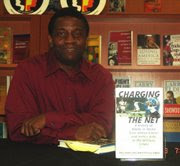
Charging the Net: A History of Blacks in Tennis from Althea Gibson and Arthur Ashe to the Williams Sisters


With every powerful serve and deft ground stroke, with every graceful volley and determined charge to the net, black tennis players – from Hall of Famers Althea Gibson, Arthur Ashe, Evonne Goolagong, and Yannick Noah to future legends James Blake and the sisters Venus Williams and Serena Williams – have forced open the sport’s shuttered gates and demanded to be acknowledged.


In Charging the Net, Cecil Harris and Larryette Kyle-DeBose draw on personal interviews and extensive research to chronicle the humiliations and triumphs of blacks in professional tennis from the 1940s to the present. For many fans and writers Ashe, Gibson, and the Williams sisters personify the achievement of African-Americans in tennis, but others too have made their mark. Charging the Net spotlights a wide range of competitors as well as the American Tennis Association, an organization that thrived despite racial segregation, thanks to such benefactors as Dr. R. Walter Johnson.


The book also introduces readers to two black officials whose success was short-lived; both have sued the United States Tennis Association, alleging discrimination based on race, gender, and age.


Harlem-trained, Harvard-educated James Blake, who overcame career-threatening injuries to achieve World Top Ten status, has written a Foreword to Charging the Net. The Afterword is written by Robert Ryland, the first black to compete in a major college tournament, who later found the doors to tennis’s premier venues marked “Whites Only.” With a clear vision, this eighty-six-year-old coach now looks at how far blacks in tennis have come and how far they have yet to travel.


With 8 pages of photographs.


Cecil Harris has written on sports for Newsday, the New York Post, The Sporting News, and USA Today, and has covered tennis for The Indianapolis Star and for Gannett Suburban Newspapers (now The Journal News) in Westchester County, New York. His other books include Breaking the Ice: The Black Experience in Professional Hockey and Call the Yankees My Daddy: Reflections on Baseball, Race, and Family. He lives in Yonkers, New York.


Larryette Kyle-DeBose is a player-captain in the Atlanta Lawn Tennis Association. She has worked as a photojournalist for the Swazi Times in Africa and is the author of The African-American Guide to Real Estate Investing. She lives in Stone Mountain, Georgia.

Monday, July 5, 2010

An excerpt from Charging the Net: A History of Blacks in Tennis


It was a turbulent year, 1968. On April 4 Dr. Martin Luther King Jr. was assassinated in Memphis, Tennessee, where he had gone to support a strike by local sanitation workers.

On June 9 Robert F. Kennedy, Jr., was assassinated in Los Angeles, at the Ambassador Hotel, minutes after speaking to cheering supporters following a victory in the California primary that might have carried him to the Democratic Party nomination for President of the United States.

The civil rights movement raged on, with scenes of rioting, looting, police brutality, and major urban cities set ablaze by those who, in the words of Mississippi activist Fannie Lou Hamer, were "sick and tired of being sick and tired."

And the Vietnam War continued apace with its disturbing visual images of death and inhumanity reaching into America’s living rooms.

In August, after he emerged as champion of the U.S. Nationals amateur tournament and shortly before play began at the inaugural U.S. Open on the new professional circuit, Arthur had dinner with a friend and fellow tennis player, a white South African named Ray Moore.

As they dined, they watched on television sickening scenes of rioting and police clubbing protesters and journalists on the streets of Chicago during the Democratic National Convention.

The two men often discussed politics and social issues, including the human rights struggle in Ashe’s homeland and the human rights struggle in Moore’s, to which much of the world had turned a blind eye.

The rule of law in Moore’s homeland was apartheid—the systematic separation of races, categorized in descending order as whites, coloreds, and blacks, and the oppression of a black majority of twenty million persons by three million whites of Dutch descent called Afrikaners, who were convinced that God had mandated their right to rule.

"Arthur and I used to discuss interminably what to do about apartheid: what’s meaningful and what’s not," Moore said. "We were both vehemently opposed to apartheid, however we differed on how best to fight it."

Apartheid outraged Lt. Arthur Ashe, Jr., then a tennis-playing officer in the United States Army. Acceptance of injustice was never part of his persona.

In 1967 he disturbed his superior officers with a public reference to South Africa’s capital city:
"Somebody should drop a hydrogen bomb on Johannesburg."

As Ashe and Moore continued to watch all hell break loose in Chicago, they talked about a quote they had seen in that day’s newspaper from rock musician Frank Zappa, leader of a band called Mothers of Invention: "The way to stop all the violence in Chicago is for the hippies to cut their hair and infiltrate the police force."

The two discussed the concept of fighting against apartheid from the inside. Arthur then decided he needed to reach out to the South African government to receive permission to visit the country to compete in the South African Open tournament—not as an "honorary white" but as a black man—and build a platform in the United States to support such an unprecedented act. That, Arthur believed, would be the most effective way to show the apartheid regime in South Africa the error of its ways and begin to sway public opinion.

It would take years for Arthur to cut through the swath of political red tape and get a visa to visit South Africa.

In 1969 and 1970 his applications were rejected by the South African government. In 1970 Arthur, then the No. 2 player in the world, and top-ranked Stan Smith visited four African nations (Kenya, Tanzania, Uganda, and Nigeria) for a series of tennis exhibitions and social events.

Arthur would also visit Cameroon the following year. He spoke of his wish to be appointed U.S. ambassador to South Africa, but that notion sounded as fanciful at the time as his ever setting foot in that country.

After all, why would a racially oppressive regime grant entry to someone who said its largest city should be A-bombed?

Arthur filed another visa application in 1973, and negotiations with South African officials continued. Among those advocating for Arthur were Robert Kelleher, a federal judge in Los Angeles who was Arthur’s first Davis Cup captain; Donald Dell, a Washington, D.C., attorney and Arthur’s agent; and Andrew Young, who in 1972 became Georgia’s first black congressman since Reconstruction.

The South African government did not want Arthur to visit, but it felt swayed somewhat by the argument that a trip by Arthur without incident could benefit the country’s image enough to lift the international sports ban that kept South Africa out of the Olympics and other high-profile events.

With both sides determined to get what they wanted from the deal, the visa application finally was accepted. In November 1973, Arthur visited South Africa.

"That trip was the start of change in South Africa—very small change," Moore said. "It was like Rosa Parks refusing to get up from her seat on the bus [in Montgomery, Alabama on December 1, 1955]. It was one small act that would have a much bigger impact."

Before the trip Arthur faced opposition from African-American activists. "People said, ‘No, you shouldn’t go. Why go all the way to South Africa for a cause when we’ve got problems right here?’" Moore remembered.

"Uncle Tom" became one of the kinder criticisms leveled at Arthur. But Ashe argued that the situation for blacks in South Africa under the foot of apartheid was worse than the situation facing African Americans.

As a black man he was not told by the U.S. government where to live. He could travel freely to any country on the globe, which would now include South Africa, whereas South African blacks were forced to live in government-created dwellings called homelands.

South African blacks did not have the right to vote. South African blacks were forced to carry passes with their personal identification that were to be presented to white authorities on demand.

South African blacks could be officially labeled "a banned person," or jailed by the government, as in the case of African National Congress leader Nelson Mandela, imprisoned since 1963 on Robben Island.

"I feel I have some credibility in talking about South Africa," Arthur wrote in his 1981 autobiography, Off the Court. "I was brought up under a similar situation, having lived in the segregated South. I have more feeling being black, intuitively, than some northerner who may have a false feeling of integration."

Arthur believed that in going to South Africa he "could play a significant role as far as raising the level of awareness within the white community both in South Africa and the United States."

Arthur set several conditions for his trip, all of which were approved by the South African government: (1) there would be no segregated audiences at the tournament in Johannesburg; (2) he would not have "honorary white" status, rather he would be recognized by white South Africa as a black man; (3) he would not have to stay in a segregated area; and (4) he could go anywhere he pleased and say anything he wanted.

A few American sports journalists accompanied him on the trip, including Frank Deford of Sports Illustrated, with whom he wrote his first memoir, Portrait in Motion, in the 1970s, and Bud Collins of the Boston Globe.

Shortly after Arthur’s arrival he had a chance meeting on the street with a colored South African poet and activist named Don Matera, regarded by his fans as "the poet of compassion."

The apartheid regime had declared Matera a "banned person," meaning he could not work, could not appear at any public event, could not speak publicly, could not be quoted by any media, and could not be in the presence of anyone other than a family member.

But when Matera heard that Arthur would be meeting that evening with a group of black South African journalists, he risked breaking an unjust law to try to talk with the American.

"When we were approaching the hall, there was a man standing by a telephone pole; it was Matera," Bud Collins recalled. "Arthur knew who he was. I didn’t. He introduced himself, and there were guys across the street watching him. The police. He said, ‘I can’t talk to you long, but good luck.’ The meeting with the black journalists was a real emotional setback for Arthur, because when he got up to speak—and we were told there were a lot of plants in the audience—a lot of people there were very critical of him. They were saying, ‘Why did you come, Arthur? You’re just making the government look good for letting you in. When you’re gone, they’ll still be kicking our black asses.’ Things like that were said. I remember that very well. Arthur was very unsettled."

Had his critics in America been proven right? Was Arthur being used by a South African government intent on getting back into the Olympic Games with no real intention of granting basic human rights to an oppressed black majority? Had he done the wrong thing by setting foot in the land of apartheid?

When Arthur left the hall Matera was still waiting outside. The words of an artist and activist whom Arthur respected, a man he did not expect to meet because of his "banned" status, fortified him and renewed his commitment to the cause.

"Obviously, Matera had known those sorts of statements would be made inside, and he could see Arthur was shaken," Collins said. "He said, ‘Arthur, you have done the right thing to come here, because you have shown our black children that a black man can succeed in a white world.’"

Arthur also visited the South African homelands, white-created dwellings for blacks designed to disfranchise them and dilute their political strength. He visited the impoverished township of Soweto, where in 1976 a violent uprising would take place resulting in the massacre of hundreds of blacks.

On this day in 1973, a makeshift tennis court was fashioned under a bridge near a schoolhouse and hundreds watched, some hanging on to fences, as Arthur, the black tennis champion from America, and Moore, the white South African tennis star, shared their craft and instilled a sense of hope.

A young black man named Mark Mathabane, wrote that he was inspired by the 1973 trip.

Mathabane’s life under apartheid and subsequent journey to America was chronicled in an autobiography, Kaffir Boy. ("Kaffir" is an Afrikaner slur equivalent to "nigger.")

The 1973 South African Open at Ellis Park was the first event under apartheid rule to have integrated seating. Moore, who did not compete in the event, made a point of sitting in a section previously reserved for blacks.

There were black ball boys, and a few black South Africans competed in the tournament—dressing side by side with whites in an integrated locker room for the first time. The atmosphere in the locker room was said to be cold enough to store meat.

Blacks, who had essentially been taught not to look a white person in the eye, did not initiate any locker-room chatter with their white counterparts.

Whites, not used to being on equal footing with blacks, silently simmered rather than bring their resentment to a boil. For South Africa this constituted radical change.

Arthur partnered with Tom Okker, a Dutchman, to win the doubles championship, 6-2, 4-6, 6-4, but he lost to Jimmy Connors in the singles final, 6-4, 7-6, 6-3. He played quite well considering his full itinerary of meetings and fact-finding tours, and his startling encounters with the black journalists and with a distinguished professor from Stellenbosch University in Capetown who could not believe the intelligent and well-spoken Ashe was really black.

"You are an exception," he told Arthur. "You are not completely black. You have some white blood in you."

Arthur hoped his trip would raise consciousness about South Africa among pro athletes, particularly tennis players, boxers, and golfers, who were accepting substantial appearance fees to compete in the country.

"I asked Arthur what South Africa was like because I had considered going there for a tournament," said Kim Sands, the black pro from Miami. "He told me being in South Africa was like stuffing yourself with twenty pancakes and then having to eat twenty more. It just made you totally sick inside. After hearing that, I didn’t go."

Arthur also hoped the international media would begin to hold accountable white South African athletes such as Gary Player, who routinely dismissed queries about apartheid with the line, "I’m a golfer, not a politician."

But Arthur truly hoped that his first of several trips to South Africa would help bring an end to the apartheid regime. Change did not come as swiftly as he expected, but eventually it came. He had made a difference.

In 1990, Nelson Mandela was released from prison. In 1992 South Africa returned to the Olympic Games for the first time in thirty-two years. In 1994 Mandela was elected president in South Africa’s first all-races election.
Arthur remembered feeling "semi-satisfied" with his tennis performance on the 1973 trip to South Africa, because of the loss to Connors. Two years later he would have another shot at Connors and a chance to write history of a different sort.

Wednesday, November 4, 2009

Mr. Ashe Goes to Africa


An excerpt from CHARGING THE NET: A HISTORY OF BLACKS IN TENNIS

It was a turbulent year, 1968.

On April 4 Dr. Martin Luther King Jr. was assassinated in Memphis, Tennessee, where he had gone to support a strike by local sanitation workers.

On June 9 Robert F. Kennedy, Jr., was assassinated in Los Angeles, at the Ambassador Hotel, minutes after speaking to cheering supporters following a victory in the California primary that might have carried him to the Democratic party nomination for President of the United States.

The civil rights movement raged on, with scenes of rioting, looting, police brutality, and major urban cities set ablaze by those who, in the words of Mississippi activist Fannie Lou Hamer, were "sick and tired of being sick and tired."

And the Vietnam War continued apace with its disturbing visual images of death and inhumanity reaching into America’s living rooms.

In August, after he emerged as champion of the U.S. Nationals amateur tournament and shortly before play began at the inaugural U.S. Open on the new professional circuit, Arthur Ashe had dinner with a friend and fellow tennis player, a white South African named Ray Moore.

As they dined, they watched on television sickening scenes of rioting and police clubbing protesters and journalists on the streets of Chicago during the Democratic National Convention.

The two men often discussed politics and social issues, including the human rights struggle in Ashe’s homeland and the human rights struggle in Moore’s, to which much of the world had turned a blind eye. The rule of law in Moore’s homeland was apartheid—the systematic separation of races, categorized in descending order as whites, coloreds, and blacks, and the oppression of a black majority of twenty million persons by three million whites of Dutch descent called Afrikaners, who were convinced that God had mandated their right to rule.

"Arthur and I used to discuss interminably what to do about apartheid: what’s meaningful and what’s not," Moore said. "We were both vehemently opposed to apartheid, however we differed on how best to fight it."

Apartheid outraged Lt. Arthur Ashe, Jr., then a tennis-playing officer in the United States Army.

Acceptance of injustice was never part of his persona. In 1967 he disturbed his superior officers with a public reference to South Africa’s capital city: "Somebody should drop a hydrogen bomb on Johannesburg."

As Ashe and Moore continued to watch all hell break loose in Chicago, they talked about a quote they had seen in that day’s newspaper from rock musician Frank Zappa, leader of a band called Mothers of Invention: "The way to stop all the violence in Chicago is for the hippies to cut their hair and infiltrate the police force."

The two discussed the concept of fighting against apartheid from the inside. Arthur then decided he needed to reach out to the South African government to receive permission to visit the country to compete in the South African Open tournament—not as an "honorary white" but as a black man—and build a platform in the United States to support such an unprecedented act.

That, Arthur believed, would be the most effective way to show the apartheid regime in South Africa the error of its ways and begin to sway public opinion.

It would take years for Arthur to cut through the swath of political red tape and get a visa to visit South Africa.

In 1969 and 1970 his applications were rejected by the South African government. In 1970 Arthur, then the No. 2 player in the world, and top-ranked Stan Smith visited four African nations (Kenya, Tanzania, Uganda, and Nigeria) for a series of tennis exhibitions and social events.

Arthur would also visit Cameroon the following year. He spoke of his wish to be appointed U.S. ambassador to South Africa, but that notion sounded as fanciful at the time as his ever setting foot in that country.

After all, why would a racially oppressive regime grant entry to someone who said its largest city should be A-bombed?

Arthur filed another visa application in 1973, and negotiations with South African officials continued. Among those advocating for Arthur were Robert Kelleher, a federal judge in Los Angeles who was Arthur’s first Davis Cup captain; Donald Dell, a Washington, D.C., attorney and Arthur’s agent; and Andrew Young, who in 1972 became Georgia’s first black congressman since Reconstruction.

The South African government did not want Arthur to visit, but it felt swayed somewhat by the argument that a trip by Arthur without incident could benefit the country’s image enough to lift the international sports ban that kept South Africa out of the Olympics and other high-profile events.

With both sides determined to get what they wanted from the deal, the visa application finally was accepted. In November 1973, Arthur visited South Africa.

"That trip was the start of change in South Africa—very small change," Moore said. "It was like Rosa Parks refusing to get up from her seat on the bus [in Montgomery, Alabama on December 1, 1955]. It was one small act that would have a much bigger impact."

Before the trip Arthur faced opposition from African-American activists. "People said, ‘No, you shouldn’t go. Why go all the way to South Africa for a cause when we’ve got problems right here?’" Moore remembered.

"Uncle Tom" became one of the kinder criticisms leveled at Arthur. But Ashe argued that the situation for blacks in South Africa under the foot of apartheid was worse than the situation facing African Americans.

As a black man, he was not told by the U.S. government where to live. He could travel freely to any country on the globe, which would now include South Africa, whereas South African blacks were forced to live in government-created dwellings called homelands. South African blacks did not have the right to vote. South African blacks were forced to carry passes with their personal identification that were to be presented to white authorities on demand. South African blacks could be officially labeled "a banned person," or jailed by the government, as in the case of African National Congress leader Nelson Mandela, imprisoned since 1963 on Robben Island.

"I feel I have some credibility in talking about South Africa," Arthur wrote in his 1981 autobiography, Off the Court. "I was brought up under a similar situation, having lived in the segregated South. I have more feeling being black, intuitively, than some northerner who may have a false feeling of integration."

Arthur believed that in going to South Africa he "could play a significant role as far as raising the level of awareness within the white community both in South Africa and the United States."

Arthur set several conditions for his trip, all of which were approved by the South African government: (1) there would be no segregated audiences at the tournament in Johannesburg; (2) he would not have "honorary white" status, rather he would be recognized by white South Africa as a black man; (3) he would not have to stay in a segregated area; and (4) he could go anywhere he pleased and say anything he wanted.

A few American sports journalists accompanied him on the trip, including Frank Deford of Sports Illustrated, with whom he wrote his first memoir, Portrait in Motion, in the 1970s, and Bud Collins of The Boston Globe.

Shortly after Arthur’s arrival he had a chance meeting on the street with a colored South African poet and activist named Don Matera, regarded by his fans as "the poet of compassion."

The apartheid regime had declared Matera a "banned person," meaning he could not work, could not appear at any public event, could not speak publicly, could not be quoted by any media, and could not be in the presence of anyone other than a family member.

But when Matera heard that Arthur would be meeting that evening with a group of black South African journalists, he risked breaking an unjust law to try to talk with the American.

"When we were approaching the hall, there was a man standing by a telephone pole; it was Matera," Bud Collins recalled. "Arthur knew who he was. I didn’t. He introduced himself, and there were guys across the street watching him. The police. He said, ‘I can’t talk to you long, but good luck.’ The meeting with the black journalists was a real emotional setback for Arthur, because when he got up to speak—and we were told there were a lot of plants in the audience—a lot of people there were very critical of him. They were saying, ‘Why did you come, Arthur? You’re just making the government look good for letting you in. When you’re gone, they’ll still be kicking our black asses.’ Things like that were said. I remember that very well. Arthur was very unsettled."

Had his critics in America been proven right? Was Arthur being used by a South African government intent on getting back into the Olympic Games with no real intention of granting basic human rights to an oppressed black majority? Had he done the wrong thing by setting foot in the land of apartheid?

When Arthur left the hall, Matera was still waiting outside. The words of an artist and activist whom Arthur respected, a man he did not expect to meet because of his "banned" status, fortified him and renewed his commitment to the cause.

"Obviously, Matera had known those sorts of statements would be made inside, and he could see Arthur was shaken," Collins said. "He said, ‘Arthur, you have done the right thing to come here, because you have shown our black children that a black man can succeed in a white world.’"

Arthur also visited the South African homelands, white-created dwellings for blacks designed to disfranchise them and dilute their political strength. He visited the impoverished township of Soweto, where in 1976 a violent uprising would take place resulting in the massacre of hundreds of blacks.

On this day in 1973, a makeshift tennis court was fashioned under a bridge near a schoolhouse and hundreds watched, some hanging on to fences, as Arthur, the black tennis champion from America, and Moore, the white South African tennis star, shared their craft and instilled a sense of hope.

A young black man named Mark Mathabane, wrote that he was inspired by the 1973 trip. Mathabane’s life under apartheid and subsequent journey to America was chronicled in an autobiography, Kaffir Boy. ("Kaffir" is an Afrikaner slur equivalent to "nigger.")

The 1973 South African Open at Ellis Park was the first event under apartheid rule to have integrated seating. Moore, who did not compete in the event, made a point of sitting in a section previously reserved for blacks.

There were black ball boys, and a few black South Africans competed in the tournament—dressing side by side with whites in an integrated locker room for the first time. The atmosphere in the locker room was said to be cold enough to store meat.

Blacks, who had essentially been taught not to look a white person in the eye, did not initiate any locker-room chatter with their white counterparts. Whites, not used to being on equal footing with blacks, silently simmered rather than bring their resentment to a boil.

For South Africa this constituted radical change.

Arthur partnered with Tom Okker, a Dutchman, to win the doubles championship, 6-2, 4-6, 6-4, but he lost to Jimmy Connors in the singles final, 6-4, 7-6, 6-3. He played quite well considering his full itinerary of meetings and fact-finding tours, and his startling encounters with the black journalists and with a distinguished professor from Stellenbosch University in Capetown who could not believe the intelligent and well-spoken Ashe was really black. "You are an exception," he told Arthur. "You are not completely black. You have some white blood in you."

Arthur hoped his trip would raise consciousness about South Africa among pro athletes, particularly tennis players, boxers, and golfers, who were accepting substantial appearance fees to compete in the country.

"I asked Arthur what South Africa was like because I had considered going there for a tournament," said Kim Sands, a black pro from Miami. "He told me being in South Africa was like stuffing yourself with twenty pancakes and then having to eat twenty more. It just made you totally sick inside. After hearing that, I didn’t go."

Arthur also hoped the international media would begin to hold accountable white South African athletes such as Gary Player, who routinely dismissed queries about apartheid with the line, "I’m a golfer, not a politician."

But Arthur truly hoped that his first of several trips to South Africa would help bring an end to the apartheid regime.

Change did not come as swiftly as he expected, but eventually it came. He had made a difference.

In 1990, Nelson Mandela was released from prison. In 1992, South Africa returned to the Olympic Games for the first time in thirty-two years. In 1994, Mandela was elected president in South Africa’s first all-races election.

Arthur remembered feeling "semi-satisfied" with his tennis performance on the 1973 trip to South Africa, because of the loss to Connors. Two years later he would have another shot at Connors and a chance to write history of a different sort.