Saturday, December 29, 2012
Juan Rivera to Yankees only makes sense
But rather than repeat what the Yankees have done so often over the years--offer an overpriced, multi-year deal to a free agent and then lament their diminishing returns at the back end of the contract--the Bronx baseball braintrust should extend a modest, two-year contract to Juan Rivera.
Rivera, who will be 34 on opening day, played the outfield for the Yankees from 2001-2003. He has never been an All-Star and will never be one. But he is a righthanded hitter with a good arm, a good glove and some pop in his bat--just the kind of bench player and occasional starter the 2013 club needs.
In today's free-agent market, Rivera could be had for $8 million over two years. Or the Yankees could offer a one-year deal worth $4 million with a club option for the 2014 season.
Rivera made $4 million for the Los Angeles Dodgers in 2012. He hit .244 with 9 home runs and 47 RBI. He can also play first base, which means the Yanks could give starter Mark Teixeira a day off once in a while.
The Yankees are likely to open 2013 with a starting outfield of Brett Gardner in left, Curtis Granderson in center and Ichiro Suzuki in right. That trio should cover plenty of ground in the outfield and steal a ton of bases.
But Granderson, Gardner and Ichiro are all lefthanded hitters. That would leave the Yankees especially vulnerable to lefthanded pitching.
Signing Rivera would allow Yankees manager Joe Girardi to sit the strike zone-challenged Granderson against a particularly tough southpaw; Gardner could move to center when Granderson sits.
Rivera could also fill in for Ichiro, no spring chicken at age 38, or be a righthanded DH--a role in which Andruw Jones struggled in 2012. (Jones has signed a free-agent contract with a team in Japan.)
Admittedly, the Yankees won't make major headlines by signing Rivera. They won't break out the carving board and serve roast beef at a Yankee Stadium news conference to re-introduce Rivera to New York.
However, Rivera can help the 2013 Yankees. The club should not wait any longer to sign him.
Saturday, October 8, 2011
Jesus Can Save 2012 Yankees


For the second straight year, the New York Yankees were eliminated from a postseason baseball series on an Alex Rodriguez strikeout.
Thursday, April 7, 2011
A Slimmer CC Sabathia Means Business in 2011
Thursday, January 13, 2011
The Indomitable Mariano Rivera

With Trevor Hoffman announcing his retirement from baseball this week, Mariano Rivera stands ready to take possession of the only significant record for relief pitchers that he does not currently hold.
Hoffman, who ended his career with the Milwaukee Brewers, retired with 601 career saves.
Rivera, the New York Yankees relief ace since 1997, has 559 saves, only 42 behind Hoffman.
The number 42 is particularly significant for Rivera. He is the only player in the major leagues still wearing No. 42.
Jackie Robinson was baseball’s most famous No. 42. Major League Baseball officially retired the number on April 15, 1997 — the 50th anniversary of Robinson becoming the majors’ first black player with the Brooklyn Dodgers.
Players who already wore No. 42 during the 1997 season were allowed to keep the number until they retired. Rivera is the only such player left.
Rivera has worn No. 42 with such distinction that he, like Robinson, will be a first-ballot Hall of Famer someday.
No relief pitcher in the history of baseball has been better than Rivera. Here’s a point-by-point comparison between Rivera and Hoffman:
Age:
Rivera: 41
Hoffman: 43
Major League Baseball seasons:
Rivera: 16
Hoffman: 18
Regular season saves:
Rivera: 559
Hoffman: 601
Regular season games:
Rivera: 978
Hoffman: 1035
Regular season ERA:
Rivera: 2.23
Hoffman: 2.87
All-Star appearances:
Rivera: 8
Hoffman: 7
Postseason saves:
Rivera: 42
Hoffman: 4
Postseason games:
Rivera: 94
Hoffman: 12
Postseason ERA:
Rivera: 0.71
Hoffman: 3.46
World Series championships:
Rivera: 5
Hoffman: 0
As the numbers clearly show, Rivera has been far superior to Hoffman in postseason games, when the stakes are highest and the pressure and media scrutiny are the greatest.
Only once did Rivera and Hoffman go head-to-head in the postseason. In the 1998 World Series, Rivera’s Yankees swept Hoffman’s San Diego Padres. Hoffman went 0-1 with one blown save and a 9.00 ERA while Rivera was perfect, saving all three games in which he appeared without allowing a run.
And Rivera is equally impressive off the field.
Growing up the son of a fisherman in La Chorrera, Panama, Rivera learned at an early age the value of hard work, religious faith and giving back to others.
Yet he remains humble, hard-working and altruistic despite the phenomenal success he has enjoyed as a Yankees reliever since 1995.
(When the Yankees won the 1996 World Series, Rivera excelled as John Wetteland’s set-up man. Rivera became the closer a year later.)
Married and the father of three sons, Rivera has helped finance the construction of an elementary school, a church and computer centers in his native country.
This winter, Rivera has delivered Christmas gifts to children in Bronx, NY, where the Yankees play their home games, and Panama. He does this without seeking publicity.
But his many contributions on the mound have been impossible to conceal.
Rivera dominates hitters with a devastating fastball that seems to grow teeth and bore in on hitters, often turning their bats into firewood. The fastball, along with his mental toughness and resilience, has set Rivera apart.
"I think the key to be successful in the closer role is to learn how to bounce back after the blown save or the losing circumstance," Rivera says. "Learn to come back from that and put that behind you."
Rivera overcame adversity in his first season as the Yankees’ relief ace. With the Yankees just four outs from winning the 1997 American League Division Series against the Cleveland Indians, Rivera gave up a game-tying home run to Sandy Alomar Jr. Cleveland went on to win the game and the series.
Rather than be haunted by that failure, Rivera came back stronger. He helped the Yankees win the next three World Series — and did not allow an earned run in any of his 18 postseason appearances in 1998 and ’99.
Consistency on the field and off has been a major reason for Rivera’s success. He doesn’t just kill time in the bullpen and wait to be called upon in the late innings. He remains a student of the game.
"Watch the game, pay attention to the hitters and once I do that I have some kind of idea on how to attack them," he says.
Yankees fans have come to expect satisfaction whenever Rivera emerges from the bullpen at Yankee Stadium to the tune of Metallica’s "Enter Sandman." And Rivera rarely disappoints.
Rivera, who recently signed a two-year contract worth $15 million a season, has averaged 35 saves a year during his career. That means sometime during the 2012 season, he should surpass Hoffman and become baseball’s all-time leader in saves.
Rivera is already baseball’s greatest relief pitcher ever. But after he breaks Hoffman’s record, there won’t be any doubt.
Monday, November 8, 2010
Sports Television Still in Need of Color Adjustment


Sports are not exempt from racial profiling. While the racial profiling in sportsworld is not as extreme or humiliating as that which exists in America’s airports and on the roads, it is mindless and infuriating nonetheless.
My skin crawled while watching an NBC Sports promo for this Sunday’s Patriots-Steelers football game. As NBC showed film of New England Patriots coach Bill Belichick (right), a voiceover announcer intoned, “the master mind.” Then we saw film of Pittsburgh Steelers coach Mike Tomlin (left) as the announcer said, “versus the master motivator.”
Both Belichick and Tomlin are Super Bowl-winning coaches. Belichick is white. Tomlin is black.
Why isn’t Tomlin credited with having a fine football mind? Why do media observers ascribe Tomlin’s success to an ability to give a fiery speech? Why are Tomlin and other black NFL playoff coaches past and present—men such as Tony Dungy, Herman Edwards and Dennis Green—reduced to mere “motivators”?
Racial profiling.
Before Tomlin became Pittsburgh’s head coach, he was the Minnesota Vikings’ defensive coordinator. Every week, he spent many hours breaking down film footage to develop game plans that included coverage and blitzing schemes designed to thwart an opposing offense.
Heady stuff. And Tomlin did it very well. The Vikings had the NFL’s top-rated defense during his tenure. And his work as Steelers coach has been so exemplary that no one believes Pittsburgh misses Bill Cowher.
Yet NBC could not bring itself to promote Patriots vs. Steelers as a battle of coaching masterminds.
Experience shows that both Super Bowl-winning coaches have to be white for that to happen.
Remember when Eric Mangini led the Jets to the playoffs in his first year as an NFL coach?
“Man-genius,” he was called. Or just “genius”? That is, until the Jets fired him after the 2008 season.
Did Mangini get dumb? Or was he never a “genius” in the first place, but rather the beneficiary of media hyperbole given to a successful white coach by a predominantly white sports media?
Mangini used to be the NFL’s youngest head coach. Raheem Morris is the NFL’s youngest head coach now.
Morris’s Tampa Bay Buccaneers are 5-3. Have you heard anyone call Morris a “genius” for turning around the previously woebegone Bucs? And you won’t hear it, even if the Bucs make the playoffs.
Racial profiling.
And it’s hardly limited to football.
On October 22, the night the Texas Rangers vanquished the New York Yankees in the American League Championship Series, former big-league catcher turned TV commentator John Flaherty said this about Texas manager Ron Washington: “He’s not the best Xs and Os guy in the world, but he gets his players to play hard.”
Flaherty, who works for the Yankees Entertainment and Sports Network, would have us believe all Washington does is motivate. The fact is Washington out-managed Yankees skipper Joe Girardi so severely that, if not for a late Yankees’ rally in Game 1, Texas could have swept the best-of-seven series.
The list of baseball managers whose success has been attributed to an ability to motivate rather than an ability to strategize and make smart in-game decisions includes Washington, Dusty Baker and two-time World Series winner Cito Gaston.
Not surprisingly, all three are black.
A generation ago, we heard and read that successful black athletes were “natural athletes” while successful white athletes were “smart” and “brainy” and “savvy.”
Some older commentators still engage in this kind of racial profiling. (Pay close attention to Bill Raftery’s work on ESPN’s and CBS’s college basketball telecasts, particularly when he talks about point guards.)
Fortunately, most people who get paid to comment on sports have become enlightened enough to drop the “natural athlete” references or the stereotype that light skin = smart and dark skin = physical.
Alas, we still have to smarten up the ones who routinely subject black coaches and managers to racial stereotypes.
Saturday, August 7, 2010
Alex Rodriguez joins baseball's 600-home run club


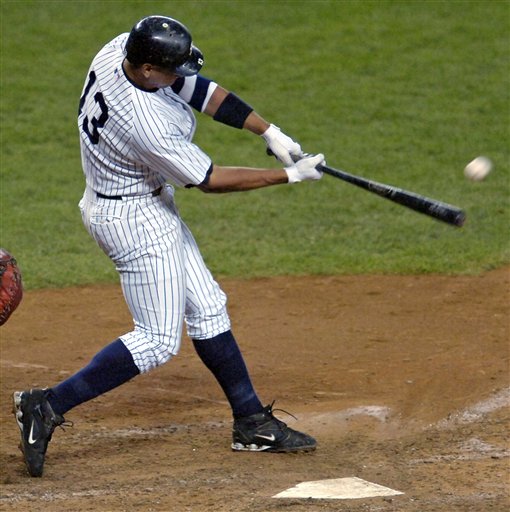
With one mighty swing on August 4, Alex Rodriguez made history.
The New York Yankees third baseman belted a fastball over the center field fence in the first inning at Yankee Stadium and became only the seventh player in Major League Baseball history to hit 600 career home runs.
Rodriguez, 35, also became the youngest player to reach the 600-home run mark. Rodriguez, a right-handed batter hit the historic home run off Toronto Blue Jays right-hander Shawn Marcum in the first inning of a game the Yankees won, 5-1.
After Rodriguez was met at home plate by his happy teammates, a crowd of 47,659 gave him a standing ovation. Because the crowd continued to cheer, Rodriguez emerged from the Yankees’ dugout and waved his batting helmet to the fans.
The other players to hit at least 600 home runs are Barry Bonds, Hank Aaron, Babe Ruth, Willie Mays, Ken Griffey Jr. and Sammy Sosa.
Rodriguez is the only man on the list who is still playing.
Rodriguez hit his 599th career home run in a July 22 victory against the Kansas City Royals. That means it took him 12 games and nearly two full weeks to hit No. 600. He had gone 17 at-bats without a base hit before the big home run.
Rodriguez is a 13-time All-Star, and he has been one of baseball’s finest players since his pro career began with the Seattle Mariners in 1994. He switched from shortstop to third base when he joined the Yankees in 2004 because the Yankees already had an All-Star shortstop, Derek Jeter.
Although he is the highest-paid player in baseball, making a reported $27.5 million a year, Rodriguez is not a sure bet to make it to the Hall of Fame in Cooperstown, New York, where the sport’s greatest players are celebrated. That’s because in 2009, after many years of denials, Rodriguez admitted he took steroids – an illegal drug – to try to improve his performances earlier in his career.
Medical experts say steroids help athletes work out for a longer period of time and recover faster from a workout so they can get stronger, and that gives them an unfair advantage over other athletes.
But because Rodriguez said he took steroids in 2003, several years before baseball began testing for the illegal drug, baseball officials did not punish him for it.
Rodriguez has not failed a drug test since baseball began steroids testing.
Many believe he will someday pass Bonds’s total of 762 and become baseball’s all-time home run king.
Who is ALEX RODRIGUEZ?
Age: 35
Date of birth: July 27, 1975
Birthplace: New York, New York
Height: 6-foot-3
Weight: 225 pounds
Job: Baseball player
Current team: New York Yankees
Position: Third base
Previous teams: Seattle Mariners, Texas Rangers
Previous position: Shortstop
Reported annual salary: $27.5 million
Family: Divorced with two daughters
MAJOR LEAGUE BASEBALL’S ALL-TIME HOME RUN LIST
(as of August 7, 2010)
1. Barry Bonds 762
2. Hank Aaron 755
3. Babe Ruth 714
4. Willie Mays 660
5. Ken Griffey Jr. 630
6. Sammy Sosa 609
7. Alex Rodriguez 600
Thursday, August 5, 2010
Sports Team Owners Are Still Channeling P.T. Barnum

P.T. Barnum, the 19th century entertainment impresario, best known for creating the world-famous Ringling Brothers and Barnum & Bailey Circus, said famously, "There’s a sucker born every minute."
Barnum, who died in 1891, could not have known how much he would have in common with professional sports franchise owners in the 21st century.
No way could Barnum have foreseen how the sham of "personal seat licenses" (PSLs), used for the building of pro sports teams at greatly reduced costs for team owners and exorbitant costs for sports fans, would be such a cash cow today.
Imagine people being asked to pay for the right to buy tickets to a newly constructed stadium, as if ticket-buying was not already an inalienable right of any citizen. And then imagine millions of fans falling for this scam – paying a team for a "license" to buy a seat and then paying again for the actual overpriced seat.
Unfortunately, common sense has not permeated the minds of enough fans to make them say, "We are going to stop paying for personal seat licenses and say to team owners. We’ll just buy tickets after you build the stadium or arena instead of giving the owners an interest-free loan worth millions of dollars."
If fans ever wake up, then the odious and usurious PSL sham would end post-haste.
Old P.T. must be laughing over in his pine box and wondering why, oh why, didn’t I think of PSLs?
Yes, there are suckers born every minute, and they walk around wearing the logo of their favorite team while believing they have a personal say in how the team conducts business.
After all, it’s "my" team, right? Yeah. Sure, it is.
That’s why the Baltimore Colts packed up their belongings in the dead of night and the football team moved to Indianapolis. And why the Browns left Cleveland high and dry and became the Baltimore Ravens. And why Al Davis moved his – not Oakland’s – Raiders to Los Angeles because he got a better deal only to move his – not L.A.’s – Raiders back to Oakland because he got a better deal. And why Davis may yet move his Raiders out of Oakland again in pursuit of a better deal.
Davis has used the PSL sham in two different cities, with perhaps a third to come.
But this is not just about Davis. His brethren in the owners’ sky boxes are doing the same thing.
The New York Jets are still peddling PSLs in the hope of filling seats at the new stadium in New Jersey that they’ll share with the New York Giants, the stadium still without a corporate name. In radio and TV ads, the Jets say ticket prices have been "reduced by 50 percent."
Usually, that last sentence would end with an exclamation point. But in this case, a 50 percent decrease is the difference between a high-priced seat and an obscenely priced seat – after the fan/sucker pays for the right to buy the overpriced seat.
The New York Yankees reduced ticket prices by 50 percent for their best seats at the new Yankee Stadium in 2009. The cost went from $2,500 per ticket per game to $1,250 per ticket per game. Still, those seats have gone largely unsold despite the Yankees’ winning the World Series in 2009 and being in first place this year.
It is tempting to assume that sports fans are finally waking up because of the vast rows of empty seats behind home plate at nearly every baseball game, or at courtside or rinkside of almost every televised pro basketball or hockey game. However, I’m convinced the empty seats have infinitely more to do with America’s ongoing economic recession than fans’ refusal to overpay the owner of their favorite team.
When the recession ends (and it should eventually), more new stadiums and arenas with even more luxury suites for the rich will be built. And even more middle-class fans will be asked to spend hard-earned money for the right to spend even more of their hard-earned money for tickets to watch the games in person.
That is, unless sports fans finally see the light and prove me and P.T. Barnum wrong.
Monday, July 26, 2010
A Yawn Greets A-Rod's Pursuit of Baseball History
Normally, this fact would be of great interest to this lifelong baseball fan and former Yankees beat writer. But A-Rod’s bid to become the seventh man in major league history to hit 600 homers only reminds me of B.B. King’s biggest hit: “The Thrill is Gone.”
To cheer A-Rod’s every at-bat, as many fans will tonight at
That is because Rodriguez is a tainted player. Tainted by his own weakness of character, which compelled him to use performance-enhancing drugs.
Rodriguez has said he used illegal drugs for three years, from 2001-03, in what he described as an ill-advised attempt to justify the then-record $273 million, 10-year contract he signed with the Texas Rangers. But he still cheated the game whether he did it for three years or three games, or whether he’s still cheating in a league that does not give players in-season blood tests to detect use of human growth hormones.
It’s impossible for me to get excited about A-Rod hitting home runs because it’s impossible to know how many of his long balls have been artificially enhanced.
It’s hard to look at A-Rod and not see the player who lied to Katie Couric’s face—and to ours—when he said on “60 Minutes” he had never used illegal drugs and never, ever would.
Because of his nationally televised turn as Pinocchio, A-Rod will always be an athlete of immense talent, and almost no credibility.
The Yankee fan in me wants to see A-Rod do well only because it helps my team. But as an adult who believes it is always best to do the right thing, I find him an extremely difficult player for whom to root.
That will be the case three years from now when A-Rod is likely to hit his 700th homer. And in the year 2015 when a 40-year-old A-Rod figures to supplant another morally challenged slugger, Barry Bonds, atop the all-time home run list.
I’ll never forget the excitement of watching Monday Night Baseball on NBC on April 8, 1974, the night Henry Aaron—baseball’s true home run king—hit No. 715 off Al Downing. “Hammerin’ Hank” had eclipsed Babe Ruth, “The Bambino,” “The Sultan of Swat,” as the greatest home run hitter ever.
But on August 7, 2007, the night Bonds hit No. 756 off Mike Bacsik to surpass Aaron, I didn’t even watch the game on ESPN.
Bonds was not worthy of the most coveted individual record in team sports then, and he isn’t now. Nor is the almost certainly drug-stained Sammy Sosa worthy of his current position of sixth place on the all-time home run list, just below Willie Mays and Ken Griffey Jr.
A-Rod, barring injury or a sudden act of vengeance from the baseball gods, will pass Sosa, Griffey, Mays, Ruth, Aaron and Bonds in the next five years. And he’ll do it in the uniform of the most successful franchise in all of team sports, a franchise representing the media capital of the world.
It will be treated as a big story in many quarters. Not this one.
When A-Rod hits No. 763, I won’t hear cheering but instead the sound of B.B. King’s famous guitar Lucille:
“The thrill is gone
“The thrill has gone away…
Wednesday, June 2, 2010
Baseball's Weakest Link: The Umpires

In light of umpire Jim Joyce's egregious call in Detroit tonight that denied Tigers right-hander Armando Galarraga a perfect game against the Cleveland Indians with two out and nobody on in the ninth inning, it is time to reprise a column I wrote last October on the pathetic state of major league baseball umpiring--and what should be done about it.
Since the 2009 postseason, baseball has done nothing to correct the atrocity that big-league umpiring has become. Thus, the work of the umpires continues to deteriorate.
Meanwhile, umpire and media hog Joe West has a publicist to tell us what city he's working in well before a series begins, which gives anyone bent on trying to fix a game exactly the kind of information he should not have.
Why MLB has not told West, "Either the publicist goes or you go," is beyond me.
West has called the New York Yankees and Boston Red Sox "a disgrace" because the teams routinely play four-hour games against each other. Perhaps having to work those games has severely cut into West's drinking time.
The real disgrace is the consistently inept work of West and his brethren in blue. Read on:
Nobody knows who’s going to win the 2009 World Series. But it is clear two weeks into the postseason who the biggest losers are: major league baseball umpires.
It has become painfully obvious that umpires can no longer call the plays in big-league games without more assistance from video replay technology.
Such technology is now used to determine disputed home run calls. Now, that same technology should be utilized to determine if a batted ball lands fair or foul, or if a player is safe or out.
There have been so many embarrassing blown calls, that it’s increasingly likely the World Series may be decided not by brilliant pitching (e.g., Orel Hershiser of the 1988 Los Angeles Dodgers), or phenomenal defense (e.g., Brooks Robinson of the 1971 Baltimore Orioles), or awe-inspiring hitting (e.g., Reggie Jackson of the 1978 New York Yankees), but rather by an umpire error.
In the fifth inning of Game 2 of the American League Championship Series, Derek Jeter was called out at first base when replays clearly showed the Yankees shortstop had beaten the throw. Instead of the Yankees having runners on 1st and 3rd with one out, they had a runner on third with two out.
Big difference.
In the 10th inning of the same game, the Yankees had the winning run on second base because an umpire ruled Los Angeles Angels shortstop Erick Aybar missed the bag on an apparent double play. Replays showed Aybar's foot brushed the bag.
Fortunately, the Yankees did not win the game because of an umpire’s misjudgment. But they could have.
Minnesota Twins fans remain convinced their team would have beaten the Yankees in Game 2 of the American League Division Series had left field umpire Phil Cuzzi not called foul an obvious leadoff double by Joe Mauer.
That Michael Cuddyer and Jason Kubel, the Twins’ next two batters, followed with base hits only added to Minnesota’s misery.
Umpire CB Bucknor personally blew three calls at first base in the opener of the Angels-Boston Red Sox A.L. Division Series.
Umpires missed three calls on the bases in Game 1 of the Philadelphia Phillies-Colorado Rockies National League Division Series.
And the Phillies’ winning rally in the ninth inning of Game 3 of the series was aided by an umpire’s mistake that put Chase Utley on base on a ball that had first hit his leg.
When viewers at home, watching frame-by-frame replays from multiple angles, are getting a better look at crucial plays than the umpires on the field, there’s a big problem.
Here’s a solution that should be implemented on Opening Day 2010:
Major League Baseball should assign a Booth Umpire to every game. The Booth Umpire will be the final arbiter on close plays on the bases, disputed home runs or whether a ball landed fair or foul.
The Booth Umpire would have the same access to frame-by-frame replays from multiple angles as TV viewers.
The Booth Umpire can buzz the home plate umpire whenever he wants to review a call, or the crew chief can ask the Booth Umpire — undoubtedly after being prompted by a team’s angry manager — to review a close call.
The argument against increased use of video replay technology is that baseball games would take too long. Well, games are already too long. The most important thing is to get the calls right.
Ball-and-strike calls would not be subject to replays. And it should not take long to decide if a ball was fair or foul, or if a runner was safe or out.
For baseball to do nothing at a time when umpires’ mistakes threaten to overshadow the excellence of the players and the excitement of the games would be the biggest error of all.
Tuesday, June 1, 2010
Baseball Continues to Sell its Soul

Major League Baseball returned to normal Tuesday as all 30 teams saw action. But that doesn't mean two appalling events the day before should be forgotten.
Monday, May 31 was Memorial Day, which used to mean every big-league team played a doubleheader.
Not the kind of day-night twinbill designed to make fans pay separate admissions that is in vogue today. But a real, honest-to-goodness doubleheader.
Two games for the price of one. A perfect way to bring families together and honor America's pastime.
Well, that used to be the case.
Unfortunately, Memorial Day 2010 was no different from any other during Bud Selig's reign of error as baseball commissioner.
Nobody played a doubleheader on Memorial Day.
And four American League teams, including the Boston Red Sox, did not play at all.
Even worse is the way Major League Baseball has turned Memorial Day--and the Fourth of July and Labor Day--into money grabs by having players wear "special, commemorative" caps.
White caps with blue bills and red and blue team logos are being sold for $37 apiece, with one dollar from each cap sold--one measly dollar--going to a military veterans' organization.
Major League Baseball would be far better off making a substantial donation to veterans' groups based on ticket proceeds instead of having players wear alternative caps.
Why must baseball be so transparent and phony? Clearly, the only reason to wear alternative caps on Memorial Day, the Fourth of July and Labor Day is to create a new source of revenue for Major League Baseball.
Why can't the New York Yankees look like themselves on national holidays during baseball season? Why must they don white caps befitting a corporate softball team in Central Park?
Wednesday, November 11, 2009
Hey, Johnny Damon, Curb Your Agent
For Johnny Damon to return as a New York Yankee in 2010, he will need to take a page from the Alex Rodriguez playbook.
And I don’t mean Damon needs to divorce his wife and then cavort with an aging rocker followed by a comely blonde actress in her early thirties.
What Damon needs to do is tell agent Scott Boras to curb the rhetoric because the Yankees can win in 2010 and beyond without him.
A-Rod nearly played his way out of
Taking
Only after A-Rod muzzled
Damon needs to borrow the
Clearly,
But his strategy often succeeds only in making a client a better-paid loser in a
Case in point: Former Seattle Mariner Alex Rodriguez of the Texas Rangers.
Another case in point:
Yet another: Former Texas Ranger Pudge Rodriguez of the
Damon turned 36 on November 3, the day before the left fielder helped the Yankees win their 27th league championship — a pro sports record.
Actually, November 3 was the day before Damon limped off the Yankee Stadium turf during Game 6 with a hamstring injury so severe he would have had to sit out Game 7, had there been one.
That is part of the problem: The Yankees need to get younger and more athletic in the outfield, and
According to
Yes, Damon has played in at least 140 games in 14 big-league seasons. But he played hurt more often than he should have to achieve that streak, and he has the weakest throwing arm of any starting outfielder in baseball.
According to
Clearly, Boras is suggesting the Yankees offer Damon a multi-year deal commensurate with the four-year, $52 million contract signed by catcher Jorge Posada who was 36 at the time, or the three-year, $45 million contract signed by relief ace Mariano Rivera who was about to turn 38, or the multi-year deal that shortstop Derek Jeter will sign to remain in pinstripes as a 36-year-old.
The Yankees won’t do that. Nor should they.
Damon, however important he was to the Yankees’ championship season, is not remotely as vital to the team as Posada — a switch-hitting catcher with power from both sides and a team leader — or Rivera — the finest relief pitcher in major league history.
The Yankees should offer Damon a two-year contract worth between $20 million-$22 million.
If
The Yankees could then pursue Los Angeles Angels free agent Chone Figgins, who is 31 and faster than Damon with a better arm.
The Yankees could also hope World Series Most Valuable Player Hideki Matsui recovers well enough from knee surgery to play 40-50 games in left field in 2010. Figgins, or a rotating group of players, could man the position the rest of the season.
If that happens, it would be, as Yankees legend Yogi Berra would say, “déjà vu all over again” for Damon.
The Boston Red Sox let Damon walk after their 2004 world championship when he rejected their four-year, $40 million offer.
The Yankees came to the rescue with a four-year, $52 million deal.
That won’t happen this time.
Tuesday, November 10, 2009
Anatomy of a Yankees Fan

My father was a Baptist minister and rooted for the New York Mets. But even at age 5, I knew he didn’t consider the Mets God’s team.
Not unless he knew that God couldn’t watch baseball without laughing because, at the time, the Mets were the biggest joke in the sport.
Logic actually dictated my father’s choice. Born on the Caribbean island of Barbados, he grew up playing cricket, baseball’s older British-born cousin.
When he immigrated to Brooklyn, he soon learned that to Americans cricket is a critter that keeps a light sleeper up at night or a top hat-wearing crooner in a Disney cartoon.
Dad chose baseball because it was the closest thing to cricket, and he chose Jackie Robinson as his favorite player because the Brooklyn Dodger was the closest thing to an icon on God’s earth.
The black community turned out in force to see Robinson once he shattered the color barrier in Major League Baseball on April 15, 1947.
Dad came to Brooklyn largely because Robinson played there.
Dad taught me how Robinson stared down racism and paved the way for a new generation of black stars in major league baseball, and how Robinson asserted his manhood with every step, every gesture, and every utterance.
Dad’s third-favorite place, after home and church, was Ebbets Field, the home of the Dodgers.
Being a Dodger fan allowed him to sit among crowds infinitely more integrated than the rest of America.
When the Dodgers traded Robinson to the New York Giants after the 1956 season, Robinson retired rather than suit up for the Dodgers’ arch rivals.
"Good for him," was Dad’s reaction.
And when the Dodgers broke Brooklyn’s heart and left for Los Angeles after the 1957 season, and took the Giants to California with them, Dad's reaction was, "Good riddance."
What Dad never said was, "Let’s go Yankees!"
Dad simply abstained from rooting for any major league team from 1957 to 1962, the year National League baseball returned to New York — well, sort of — in the form of the Mets.
Dad treated the Mets as lineal descendants of the Dodgers and Giants, which of course they were not.
The rational side of Dad’s brain knew the Metropolitan Baseball Club of New York was little more than baseball’s naked effort to capitalize financially on fans eager to support a second pro baseball team in the nation’s largest city.
"So why didn’t you just switch to the Yankees?" I asked with youthful naiveté.
Dad glared at me as if I had questioned God’s existence. I’ll never forget him sitting me down and explaining with the patience of Job, "If you were black then and you knew what was going on, you didn’t root for the Yankees.
"The Yankees," he said, virtually expectorating the words, "they didn’t want black players. That American League, especially the Yankees and Boston, they didn’t want black players."
That I would learn was an incontrovertible fact, almost as perplexing to my young mind as the knowledge that some black Africans had participated in the slave trade.
I said almost.
The New York Yankees did not have a black player until Elston Howard in 1955 — eight years after Robinson’s Dodgers debut, seven years after Roy Campanella joined the Dodgers, six years after Monte Irvin suited up for the Giants, and the year after the Giants won the World Series with a young black star named Willie Mays running down everything in center field!
Boston? Pitiful Boston was the last major league team to field an African-American player: Pumpsie Green in 1959.
"The Yankees saw the Giants win the World Series with black stars, and the Giants played at the Polo Grounds in Manhattan," Dad explained.
"And the Dodgers, playing right here in Brooklyn, finally beat the Yankees in the ’55 World Series with black stars — Jackie, Campy [Campanella], Don Newcombe. The Yankees knew by then they had to get with the program and sign some black fellas. But for the longest time, they didn’t want us."
That’s why Dad didn’t like the Yankees.
And my brother Andrew, three years older than I, didn’t like the Yankees either because he was going through that phase in which he wanted to be exactly like Dad in every way.
For whatever reason, I never went through that phase.
Dad was a minister. I grew up to become a journalist and author.
Dad and Andrew rooted passionately for the Mets. I rooted just as passionately for the Yankees — a team that had black players by the time Dad introduced me to baseball.
I sometimes reminisce about the passionate arguments I used to have with my father and brother about baseball:
Which team is better, Yankees or Mets?
Which was the better ballpark to watch a game, Yankee Stadium or Shea Stadium?
I still can’t believe they thought that Flushing dump was somehow superior to the great ballpark in the Bronx.
Dad and Andrew are gone now. So are Shea Stadium and the original Yankee Stadium. How I miss the fun and passion of those arguments.
And how grateful I am to have had a father who instilled in me and nurtured a love of baseball — a truly beautiful game, no matter how much today’s players try to ruin it.
Monday, November 9, 2009
A Yankees' Celebration Without The Boss
As someone who covered the dynastic New York Yankees in the mid-1990s, I had to laugh at the oft-repeated comment that this year’s World Series championship is for the team’s principal owner, George Steinbrenner.
At the victory celebration at City Hall last Friday, speaker after speaker, from Mayor Bloomberg to manager Joe Girardi to captain Derek Jeter to broadcaster Suzyn Waldman, said, “This one is for The Boss.”
So all the other championships won during Steinbrenner’s reign, which began in 1973, were for somebody else?
For whom? Frank Sinatra? Team mascot Rudy Giuliani?
Every Yankees championship during the Steinbrenner Era—1977, 1978, 1996, 1998, 1999, 2000 and 2009—has been for The Boss.
It’s still his team. It’s still his money.
Apparently, the aforementioned speakers felt better about declaring the Yankees’ 27th World Series title as one for The Boss.
After all, George M. Steinbrenner III is 79 years old.
Steinbrenner is the Lion in Winter, no longer running the team in hands-on fashion, having ceded those responsibilities to sons Hal and Hank.
Steinbrenner is no longer the clenched face of the Yankees’ franchise.
Indeed, if an article by Franz Lidz in Portfolio magazine last year can be believed—and I believe it—Steinbrenner suffers from dementia and is not fully aware of what is happening with the franchise.
Statements issued nowadays by the Yankees in Steinbrenner’s name are actually written by the office of his publicist, Howard Rubenstein.
This lends a certain Wizard of Oz aspect to Steinbrenner’s current status.
Before the postseason, the Yankees announced Steinbrenner would attend some games at the new Yankee Stadium.
He did not.
When the Yankees received their world championship trophy on the field last Wednesday night, The Boss was neither seen nor heard.
I can only hope he knows what his team accomplished and will long enjoy the memories of the 2009 season with family and friends.
During my years as a Yankees beat writer, Steinbrenner was at his megalomaniacal best (or worst), not above big-timing me by selectively handing out choice information to reporters at larger media organizations.
On many occasions during Yankees’ spring training, when Steinbrenner was accessible, I urged him to return my phone calls during the season because my editors had become convinced that I was being outworked by competitors at other newspapers.
“Absolutely,” Steinbrenner would say. “A lot of my players live in
Then, a new baseball season would begin, and Steinbrenner would run his New York-based team from his adopted hometown of
Whenever people ask me what I think of Steinbrenner, I always say I would like him more if I had never met him.
That’s because a Yankee fan’s perspective would have been all I had.
Steinbrenner has always spent liberally and aggressively to assemble the best team money can buy.
His teams don’t always win, but you can’t help but appreciate a team owner who wants to win just as much as the fans.
Here is my favorite Steinbrenner story, one that gets better with age, even though the Yankees owner ended up big-timing me again:
At the 1996 Olympic Games in
I thought such an interview would not only be newsworthy, but that it would also impress the executive editor at Gannett-Westchester who had also personalized my inability to get Steinbrenner to talk to me.
Except that the executive editor’s personalization faulted me, not Steinbrenner.
I had already gone through the media liaison for USA Boxing to request a few minutes of Steinbrenner’s time that day at the boxing venue,
Steinbrenner showed up, as scheduled, and was booed by thousands of spectators when he was introduced between rounds of a fight.
Right after Angelo Dundee, Muhammad Ali’s former trainer, was introduced to hearty cheers, Steinbrenner was roundly booed.
I couldn’t pass up an opportunity to ask a spectator from a country where baseball is not at all popular why he would boo Steinbrenner.
So I asked a young man seated several rows behind me, a member of the Mongolian boxing team.
With a wide grin, the Mongolian said, “He greedy.”
Wonderful!
I planned to ask Steinbrenner about the Mongolian’s response—my last question, not my first—but I didn’t get the chance.
I saw Steinbrenner head for the exit during the next round. I ran after him and got his attention.
“No, I haven’t forgotten,” he said. “We’ll talk. I have to do something for NBC. But we’ll talk.”
“You’re coming back then?” I asked quickly because I had to stay to cover the fights.
“We’ll talk,” he said again before leaving.
I never saw him again during the Olympics, and I was unable to get him on the phone. A USA Boxing official told me Steinbrenner might have stayed longer if not for the booing.
Well, The Boss would have been cheered wildly in
Friday, November 6, 2009
Yankees, Stop Jerking Joba Around

Ninety-six days until pitchers and catchers report to spring training.
That’s what New York Yankees manager Joe Girardi says team owner George Steinbrenner told him during a conversation before today’s World Series victory parade.
That means it’s not too soon for the Yankees’ hierarchy to let its key players know exactly what their roles will be in 2010.
It’s time for the Yankees to tell Joba Chamberlain to not only avoid driving under the influence this off-season but also to start preparing himself mentally to be a full-time relief pitcher from hereon.
Forget Hank (son of George) Steinbrenner’s bluster about Joba having the potential to be the Yankees’ answer to Boston Red Sox ace Josh Beckett.
He doesn’t.
Anyone who watched Joba labor as a starter in 2009 and then return to his dominating self as a reliever in the postseason should know the 24-year-old belongs in the bullpen, as the heir apparent to Mariano Rivera.
The barrel-chested Joba was one of the most popular players among the millions of fans at today’s parade along the Canyon of Heroes up Broadway (not down Broadway; the parade route goes against the normal flow of traffic).
Fans chanted "Jo-ba! Jo-ba! Jo-ba!" even though New York City neglected to put the players’ names on the side of the floats.
It has been easy to recognize Joba since his fist-pumping, flame-throwing debut in the second half of the 2007 season.
Joba is at his best when he can come into games and blow hitters away with a three-pitch repertoire — sinking two-seam fastball, four-seam fastball and slider — rather than try to pace himself as a starter throwing four pitches that he cannot always command.
The Yankees should admit the Joba-as-starter experiment failed. There is no need for a reprise in 2010.
The Yankees are well-stocked in the rotation with CC Sabathia, A.J. Burnett, Phil Hughes, Chien-Ming Wang, Ian Kennedy and Andy Pettitte.
Yes, Hughes excelled as Rivera’s set-up man during the regular season. But the 23-year-old had a deer-in-the-headlights look in the postseason.
Hughes has the temperament to be a starter.
Joba, with his demonstrative, take-on-all-comers persona on the mound, is better suited for the bullpen.
Let him be a sponge next to Rivera in the Yankees’ bullpen. Let him soak up knowledge from the greatest relief pitcher in baseball history.
As Yankees players celebrated a pro-sports record 27th league championship on the podium at Yankee Stadium on Wednesday night, a giddy Rivera said he wanted to pitch "five more years."
Magnificent as Rivera is, he will be 40 on November 29.
Rivera does not have five great seasons left. He may have two at best. That would make Rivera the closer through 2011, when his contract expires.
The Yankees should not wait until then to find his replacement. They should not assume they can just buy another team’s closer on the free agent market and plug him in.
Rivera’s successor is already on the Yankees’ roster. His name is Joba Chamberlain. It would be wise of the Yankees to let him know it.
Now.
Thursday, October 29, 2009
The Black Sportswriter & Other Endangered Species

When I joined the New York Yankees beat in 1995, I became the first black sportswriter ever assigned to cover the Yankees full-time (spring training, regular season games, playoff games, home games, road games). I know that is mere trivia to some people, but it mattered to me. Yet at the same time, I didn’t accept congratulations because it was really an indictment of my profession.
I had done my homework on blacks in the sports media, and I learned about such men as Sam Lacy of the Baltimore Afro-American and Wendell Smith of the Pittsburgh Courier, pioneers who wrote for black-owned weekly newspapers.
Lacy and Smith wrote cogent columns that championed the cause for African-Americans in Major League Baseball before Jackie Robinson broke the color barrier.
Smith helped find black families with whom Jackie and Rachel Robinson could stay in National League cities during an era in which racism precluded a black ballplayer from frequenting the same hotel or restaurant as his white teammates.
I recall the story of how Lacy had actually been barred from the press box at Brooklyn’s Ebbets Field because of racism only to have several white sportswriters, including Dick Young, join him during the game on the press box roof in solidarity.
I knew I wouldn’t have had an opportunity to cover Major League Baseball games were it not for men like Lacy and Smith and Art Rust Jr. of the New York Amsterdam News (and later WNBC-TV in New York) and Chuck Johnson of USA Today and Larry Whiteside, a former Boston Red Sox beat writer for The Boston Globe.
Those men opened the door for me.
Nobody ever tried to bar me from the press box. The overt racism of the past is gone, but it’s still extremely rare to find a black beat writer in Major League Baseball.
Why? The overwhelming majority of sports editors at daily newspapers are white men and they tend not to assign blacks to cover baseball.
Why? Only those sports editors can answer that. And I know they have not done nearly enough soul searching to formulate a coherent response.
To this day black sportswriters at daily newspapers tend to be segregated into two sports: basketball and boxing.
Black athletes are predominant in both of those sports. But that alone does not explain why black sportswriters at daily papers are steered toward those two sports.
In the National Football League, roughly 70 percent of the players are black. But there aren’t many black football beat writers, either.
Why? Again, only those sports editors can answer that.
I honestly don’t believe any of this will change unless a white sports editor at a prominent daily newspaper does an Al Campanis — he publicly says or writes something so egregiously racist about the lack of racial diversity on the sports staffs of daily newspapers that it shames the industry into taking corrective action.
If I were you, I wouldn’t hold my breath until that happens.
I never had a racial slur directed at me in a press box or anywhere else within a stadium. But once I began to travel outside New York to cover sports events, I sometimes encountered difficulty. The gatekeepers did not recognize my face, so my entering an out-of-town ballpark was not always a guarantee.
I have found over the years that men who are elderly and white often guard the press gate. And an inordinate number of those men are retired police officers or moonlighting police officers. And generally, their only significant contact with a black man has been as a “collar,” their suspect or detainee. So their antennae become activated, and their pulse probably quickens, when a black man approaches — even a harmless one like me with media credentials.
How do I know this?
Well, the vigor with which these men have sometimes challenged my right to enter a stadium compelled me to find out what they do or have done for a living.
Even after I began wearing my credentials (then a 2-1/4-inch x 3-1/2-inch card from the Baseball Writers Association of America and a credential for that series of games issued by the home team) in a pouch on a chain around my neck, press gate guards would give it a scrutiny far beyond that reserved for white reporters.
Had this happened once or twice, I would have said no big deal. I wouldn’t even be telling you about it. But to be misidentified as a messenger or, worse, an intruder at major league ballparks in Detroit, Cleveland, Milwaukee, Oakland, Minneapolis, and Toronto, to name just a few cities, constituted something more insidious than a mere coincidence.
On a Yankees road trip to Minnesota, I sensed my colleagues’ skepticism about the frequency of my difficulty entering stadiums. So five of the eight regular beat writers assigned to cover the Yankees agreed one day to arrive at the Metrodome at the same time (we didn’t always travel from hotel to stadium together) and walk past the guard one by one. Each man would show his credentials to the guard and walk on by. I would go last.
Well, the New York Daily News, Newsday, The Record of Bergen County (New Jersey), and The Star-Ledger of Newark (New Jersey) all went inside without a hitch.
Then in walked the black guy from Gannett-Westchester Newspapers.
“Hey, hey!” the elderly white guard snapped while grabbing my right arm. “Where you goin’?”
My colleagues laughed. The guard clearly had not looked at my credentials at all. He looked only at my skin.
My face, usually a rich brown, probably turned crimson because I could feel it burning, more out of anger than embarrassment.
“He’s one of us,” the Daily News guy told the guard.
Those words seemed to satisfy the guard more than the official media credentials I had on a chain around my neck, no more than a few feet from his nose.
Unfair as this may sound, I still believe I could have walked into the Metrodome that day behind Ted Bundy, Jeffrey Dahmer, John Wayne Gacy, and Albert DiSalvo and I would have been the one that guard grabbed for in anger.
It’s all about the hue . . . and the occasionally warped reaction that it engenders.
My colleagues never doubted me again, at least not on that issue. They urged me to complain to the Minnesota Twins organization.
That’s what I hoped they would say. Prior to that episode, I always considered the press gate slights part of the treacherous territory, and I honestly believed no team official would do anything about it unless there were eyewitnesses.
This time I had four. A Twins media relations man apologized. I accepted it and moved on.
That’s as bad as it got for me as a Major League Baseball beat writer, until my final days on the Yankees beat, which in the overall scheme of things, paled in comparison to what Messrs. Lacy and Smith had to bear.
Wednesday, October 28, 2009
Pedro Martinez Still Calls The Yankees His Daddy

Ever have a hard time coming up with a title for some creative project – a book, a song, a painting? Or maybe a name for your small business?
Well, don’t worry about it. Just keep doing the work. That title or company name will soon come to you, often in a most unusual way.
Such was the case with my third book, Call the Yankees My Daddy.
And for that I have to thank Pedro Martinez, who is scheduled to start World Series Game 2 at Yankee Stadium tomorrow night.
The frustration that had long simmered inside Pedro Martinez finally came rushing to the surface on September 24, 2004. The one baseball team the future Hall of Fame pitcher could not dominate – the New York Yankees – had beaten him again on this night, for the second time in six days, leaving him at a loss to explain why.
In a small interview area at Boston’s Fenway Park, the right-hander tried to speak through the pain about those Yankees, the team against whom he failed to protect a 4-0 lead in the ultimate game of the American League Championship Series at Yankee Stadium.
Because of his failure that night, the Yankees, and not the Red Sox, advanced to the World Series. The Yankees had stung Martinez yet again.
Could the Dominican Diva find the words to express such anguish?
“What can I say?” he began with a shrug. “I just tip my hat and call the Yankees my daddy.”
Words that will always bring a smile to the face of a Yankee fan, including this one. I pledged allegiance to the Yankees decades ago, when they were as anguished as Martinez, an erstwhile dynasty left in ruin.
So frequent were the Yankee losses, so constant the teasing from others, including my own father and brother who rooted for other teams, that I could relate to Joe Hardy, the long-suffering fan from Damn Yankees, who sold his soul to the devil to see his team beat the Yankees and win the championship just once.
The only difference was I wanted to see the Yankees win just once.
Fortunately, without having to sell my soul, I saw the Yankees of the mid-1970s become champions again, and also-rans a decade later, and champions yet again in 1996 – this time with me in a front-row seat as a newspaper reporter covering their renaissance – and then a dynasty no more.
The Yankees have taken me on an emotional rollercoaster ride for decades, allowing me to experience a gamut of emotions – from the exultation of the overachieving 1996 team from which Major League Baseball’s last dynasty was spawned to the heartbreak of the 2004 team that squandered a 3-0 ALCS lead (to the Red Sox, of all teams) and ended up historic losers.
Yet there was never any doubt that I would come back for another ride. A baseball fan always does.
Baseball is the best friend that goes away every winter but returns right on time every spring.
Baseball is the constant that endures while so much of life changes.
Baseball is what formed an unbreakable bond between father and sons and between brothers in my Brooklyn, New York household.
And baseball became a needful diversion that helped me endure the losses of those closest to me. Baseball isn’t perfect, far from it, but thankfully it is always there.
Over the years I have spent more time with baseball and the Yankees than just about anything or anyone else, and I’ve learned quite a few things – about what’s good in the game and what isn’t, about myself and my family, about life and death.
Those are the things I share with readers in Call the Yankees My Daddy. But I don’t do it in chronological order, not in the typical way.
Instead, I share these things with you the way Lola, the temptress from Damn Yankees, might have done it: I’ll give you a little bit of this and a little bit of that, with an emphasis on the latter.
Oh, by the way, Yankees over Phillies in 6. And it will be fun to watch Pedro try to get my boys out tomorrow night.