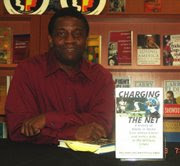
Tuesday, November 10, 2009

Anatomy of a Yankees Fan


My father was a Baptist minister and rooted for the New York Mets. But even at age 5, I knew he didn’t consider the Mets God’s team.

Not unless he knew that God couldn’t watch baseball without laughing because, at the time, the Mets were the biggest joke in the sport.

Logic actually dictated my father’s choice. Born on the Caribbean island of Barbados, he grew up playing cricket, baseball’s older British-born cousin.

When he immigrated to Brooklyn, he soon learned that to Americans cricket is a critter that keeps a light sleeper up at night or a top hat-wearing crooner in a Disney cartoon.

Dad chose baseball because it was the closest thing to cricket, and he chose Jackie Robinson as his favorite player because the Brooklyn Dodger was the closest thing to an icon on God’s earth.

The black community turned out in force to see Robinson once he shattered the color barrier in Major League Baseball on April 15, 1947.

Dad came to Brooklyn largely because Robinson played there.

Dad taught me how Robinson stared down racism and paved the way for a new generation of black stars in major league baseball, and how Robinson asserted his manhood with every step, every gesture, and every utterance.

Dad’s third-favorite place, after home and church, was Ebbets Field, the home of the Dodgers.

Being a Dodger fan allowed him to sit among crowds infinitely more integrated than the rest of America.

When the Dodgers traded Robinson to the New York Giants after the 1956 season, Robinson retired rather than suit up for the Dodgers’ arch rivals.

"Good for him," was Dad’s reaction.

And when the Dodgers broke Brooklyn’s heart and left for Los Angeles after the 1957 season, and took the Giants to California with them, Dad's reaction was, "Good riddance."

What Dad never said was, "Let’s go Yankees!"

Dad simply abstained from rooting for any major league team from 1957 to 1962, the year National League baseball returned to New York — well, sort of — in the form of the Mets.

Dad treated the Mets as lineal descendants of the Dodgers and Giants, which of course they were not.

The rational side of Dad’s brain knew the Metropolitan Baseball Club of New York was little more than baseball’s naked effort to capitalize financially on fans eager to support a second pro baseball team in the nation’s largest city.

"So why didn’t you just switch to the Yankees?" I asked with youthful naiveté.

Dad glared at me as if I had questioned God’s existence. I’ll never forget him sitting me down and explaining with the patience of Job, "If you were black then and you knew what was going on, you didn’t root for the Yankees.

"The Yankees," he said, virtually expectorating the words, "they didn’t want black players. That American League, especially the Yankees and Boston, they didn’t want black players."

That I would learn was an incontrovertible fact, almost as perplexing to my young mind as the knowledge that some black Africans had participated in the slave trade.

I said almost.

The New York Yankees did not have a black player until Elston Howard in 1955 — eight years after Robinson’s Dodgers debut, seven years after Roy Campanella joined the Dodgers, six years after Monte Irvin suited up for the Giants, and the year after the Giants won the World Series with a young black star named Willie Mays running down everything in center field!

Boston? Pitiful Boston was the last major league team to field an African-American player: Pumpsie Green in 1959.

"The Yankees saw the Giants win the World Series with black stars, and the Giants played at the Polo Grounds in Manhattan," Dad explained.

"And the Dodgers, playing right here in Brooklyn, finally beat the Yankees in the ’55 World Series with black stars — Jackie, Campy [Campanella], Don Newcombe. The Yankees knew by then they had to get with the program and sign some black fellas. But for the longest time, they didn’t want us."

That’s why Dad didn’t like the Yankees.

And my brother Andrew, three years older than I, didn’t like the Yankees either because he was going through that phase in which he wanted to be exactly like Dad in every way.

For whatever reason, I never went through that phase.

Dad was a minister. I grew up to become a journalist and author.

Dad and Andrew rooted passionately for the Mets. I rooted just as passionately for the Yankees — a team that had black players by the time Dad introduced me to baseball.

I sometimes reminisce about the passionate arguments I used to have with my father and brother about baseball:

Which team is better, Yankees or Mets?

Which was the better ballpark to watch a game, Yankee Stadium or Shea Stadium?

I still can’t believe they thought that Flushing dump was somehow superior to the great ballpark in the Bronx.

Dad and Andrew are gone now. So are Shea Stadium and the original Yankee Stadium. How I miss the fun and passion of those arguments.

And how grateful I am to have had a father who instilled in me and nurtured a love of baseball — a truly beautiful game, no matter how much today’s players try to ruin it.

Monday, November 9, 2009

A Yankees' Celebration Without The Boss


As someone who covered the dynastic New York Yankees in the mid-1990s, I had to laugh at the oft-repeated comment that this year’s World Series championship is for the team’s principal owner, George Steinbrenner.


At the victory celebration at City Hall last Friday, speaker after speaker, from Mayor Bloomberg to manager Joe Girardi to captain Derek Jeter to broadcaster Suzyn Waldman, said, “This one is for The Boss.”


So all the other championships won during Steinbrenner’s reign, which began in 1973, were for somebody else?


For whom? Frank Sinatra? Team mascot Rudy Giuliani?


Every Yankees championship during the Steinbrenner Era—1977, 1978, 1996, 1998, 1999, 2000 and 2009—has been for The Boss.


It’s still his team. It’s still his money.


Apparently, the aforementioned speakers felt better about declaring the Yankees’ 27th World Series title as one for The Boss.


After all, George M. Steinbrenner III is 79 years old.


Steinbrenner is the Lion in Winter, no longer running the team in hands-on fashion, having ceded those responsibilities to sons Hal and Hank.


Steinbrenner is no longer the clenched face of the Yankees’ franchise.


Indeed, if an article by Franz Lidz in Portfolio magazine last year can be believed—and I believe it—Steinbrenner suffers from dementia and is not fully aware of what is happening with the franchise.


Statements issued nowadays by the Yankees in Steinbrenner’s name are actually written by the office of his publicist, Howard Rubenstein.


This lends a certain Wizard of Oz aspect to Steinbrenner’s current status.


Before the postseason, the Yankees announced Steinbrenner would attend some games at the new Yankee Stadium.


He did not.


When the Yankees received their world championship trophy on the field last Wednesday night, The Boss was neither seen nor heard.


I can only hope he knows what his team accomplished and will long enjoy the memories of the 2009 season with family and friends.


During my years as a Yankees beat writer, Steinbrenner was at his megalomaniacal best (or worst), not above big-timing me by selectively handing out choice information to reporters at larger media organizations.


On many occasions during Yankees’ spring training, when Steinbrenner was accessible, I urged him to return my phone calls during the season because my editors had become convinced that I was being outworked by competitors at other newspapers.


“Absolutely,” Steinbrenner would say. “A lot of my players live in Westchester during the season. And [manager Joe] Torre lives in Westchester, too. I’ll take care of you. Don’t worry.”


Then, a new baseball season would begin, and Steinbrenner would run his New York-based team from his adopted hometown of Tampa, and my phone calls would go largely unreturned.


Whenever people ask me what I think of Steinbrenner, I always say I would like him more if I had never met him.


That’s because a Yankee fan’s perspective would have been all I had.


Steinbrenner has always spent liberally and aggressively to assemble the best team money can buy.


His teams don’t always win, but you can’t help but appreciate a team owner who wants to win just as much as the fans.


Here is my favorite Steinbrenner story, one that gets better with age, even though the Yankees owner ended up big-timing me again:


At the 1996 Olympic Games in Atlanta, where I covered boxing for Gannett News Service and USA Today, I tried to set up a one-on-one interview with Steinbrenner, then a vice president for the U.S. Olympic Committee.


I thought such an interview would not only be newsworthy, but that it would also impress the executive editor at Gannett-Westchester who had also personalized my inability to get Steinbrenner to talk to me.


Except that the executive editor’s personalization faulted me, not Steinbrenner.


I had already gone through the media liaison for USA Boxing to request a few minutes of Steinbrenner’s time that day at the boxing venue, Georgia Tech University.


Steinbrenner showed up, as scheduled, and was booed by thousands of spectators when he was introduced between rounds of a fight.


Right after Angelo Dundee, Muhammad Ali’s former trainer, was introduced to hearty cheers, Steinbrenner was roundly booed.


I couldn’t pass up an opportunity to ask a spectator from a country where baseball is not at all popular why he would boo Steinbrenner.


So I asked a young man seated several rows behind me, a member of the Mongolian boxing team.


With a wide grin, the Mongolian said, “He greedy.”


Wonderful!


I planned to ask Steinbrenner about the Mongolian’s response—my last question, not my first—but I didn’t get the chance.


I saw Steinbrenner head for the exit during the next round. I ran after him and got his attention.


“No, I haven’t forgotten,” he said. “We’ll talk. I have to do something for NBC. But we’ll talk.”


“You’re coming back then?” I asked quickly because I had to stay to cover the fights.


“We’ll talk,” he said again before leaving.


I never saw him again during the Olympics, and I was unable to get him on the phone. A USA Boxing official told me Steinbrenner might have stayed longer if not for the booing.


Well, The Boss would have been cheered wildly in New York last week.


Saturday, November 7, 2009

Today's College Football Playoff KOs Oregon, Iowa, LSU, Notre Dame


The easiest column for any sportswriter is one calling for a playoff system in major college football, especially since President Barack Obama says he’s for it.


Forget it. It won’t happen, nor should it happen.


Every major college football team plays at least 12 games now. To add a four-team or eight-team playoff to determine a national champion would prolong the season to almost-NFL length (without paying the athletes) and make a mockery of the idea that these players are really student-athletes.


There has to be some time left for class lectures, term papers, research projects, mid-term exams and finals, right?


Here’s what is good about the current system in college football: The regular season acts as a de facto playoff tournament—weeding out the unworthy teams every weekend while allowing a dark horse or two to play its way into one of the five Bowl Championship Series games (Rose Bowl, Orange Bowl, Fiesta Bowl, Sugar Bowl, BCS Championship Game).


Here’s what is not so good: The Associated Press media poll, the USA Today Coaches’ poll and the computer-generated polls that all weigh too heavily toward teams from the six so-called “power conferences”: the Southeastern Conference; the Big 10 (which actually has 11 teams); the Big 12; the Pacific 10; the Atlantic Coast Conference; and the Big East.


Many people hate the current system.


But you know what? It works. Every week, the system separates contenders from pretenders.


Today’s games knocked out four pretenders:


· Oregon, coming off a devastating 47-20 romp over USC last week, showed it’s not quite ready for prime time, losing at Stanford 51-42;


· Iowa was 9-0 before losing at home to Northwestern, 17-10;


· LSU, which could have won the SEC crown and staked a claim for a national title berth, lost at Alabama, 24-15; and


· Notre Dame, the greedy football independent that plays every home game on NBC and every road game on another major network, was humiliated at home by Navy, 23-21.


So now we know, on the second weekend of November, that one of four teams will win the national championship: Texas (Big 12), Florida (SEC), Alabama (SEC) or long shot Cincinnati (Big East).


The rest of the season will determine which school’s 300-pounders get to hold up the fancy crystal football on the field in Pasadena, CA on January 7.


A school from one of the power conferences will win the national championship every year. That’s just the way it is in college football.


Media conglomerates such as Disney (owners of ESPN and ABC), Viacom (owners of CBS) and News Corporation (owners of Fox Sports) pay billions of dollars to televise major college football.


And the power conferences, major bowl committees and mid-major conferences—in that order—are sharing those billions for producing mostly exciting games that garner high TV ratings.


Hence, there is no incentive for the NCAA to use January to stage a football version of college basketball’s “March Madness.”


It is better to be a Gonzaga or George Mason in college basketball than to be a Boise State or TCU in college football.


In football, the best that Boise State of the Western Athletic Conference or TCU of the Mountain West Conference can hope for is to get into a BCS game in January.


It just won’t be the national championship game.


Last year, Utah of the Mountain West crashed the party—and then embarrassed Alabama in the Sugar Bowl.


The year before, it was Hawaii of the WAC—and then the Rainbows got eviscerated by Georgia in the Sugar Bowl.


And the year before that, Boise State played party-crasher and stunned Oklahoma in the Fiesta Bowl—one of the most exciting bowl games ever.


So, I’m sorry, Mr. President, but major college football will basically stay the way it is, with a little tweaking here and there to give the Boise States and TCUs more of a reason to hope audaciously.


(How does he find time to watch college football? I need health care.)


Friday, November 6, 2009

Yankees, Stop Jerking Joba Around


Ninety-six days until pitchers and catchers report to spring training.

That’s what New York Yankees manager Joe Girardi says team owner George Steinbrenner told him during a conversation before today’s World Series victory parade.

That means it’s not too soon for the Yankees’ hierarchy to let its key players know exactly what their roles will be in 2010.

It’s time for the Yankees to tell Joba Chamberlain to not only avoid driving under the influence this off-season but also to start preparing himself mentally to be a full-time relief pitcher from hereon.

Forget Hank (son of George) Steinbrenner’s bluster about Joba having the potential to be the Yankees’ answer to Boston Red Sox ace Josh Beckett.

He doesn’t.

Anyone who watched Joba labor as a starter in 2009 and then return to his dominating self as a reliever in the postseason should know the 24-year-old belongs in the bullpen, as the heir apparent to Mariano Rivera.

The barrel-chested Joba was one of the most popular players among the millions of fans at today’s parade along the Canyon of Heroes up Broadway (not down Broadway; the parade route goes against the normal flow of traffic).

Fans chanted "Jo-ba! Jo-ba! Jo-ba!" even though New York City neglected to put the players’ names on the side of the floats.

It has been easy to recognize Joba since his fist-pumping, flame-throwing debut in the second half of the 2007 season.

Joba is at his best when he can come into games and blow hitters away with a three-pitch repertoire — sinking two-seam fastball, four-seam fastball and slider — rather than try to pace himself as a starter throwing four pitches that he cannot always command.

The Yankees should admit the Joba-as-starter experiment failed. There is no need for a reprise in 2010.

The Yankees are well-stocked in the rotation with CC Sabathia, A.J. Burnett, Phil Hughes, Chien-Ming Wang, Ian Kennedy and Andy Pettitte.

Yes, Hughes excelled as Rivera’s set-up man during the regular season. But the 23-year-old had a deer-in-the-headlights look in the postseason.

Hughes has the temperament to be a starter.

Joba, with his demonstrative, take-on-all-comers persona on the mound, is better suited for the bullpen.

Let him be a sponge next to Rivera in the Yankees’ bullpen. Let him soak up knowledge from the greatest relief pitcher in baseball history.

As Yankees players celebrated a pro-sports record 27th league championship on the podium at Yankee Stadium on Wednesday night, a giddy Rivera said he wanted to pitch "five more years."

Magnificent as Rivera is, he will be 40 on November 29.

Rivera does not have five great seasons left. He may have two at best. That would make Rivera the closer through 2011, when his contract expires.

The Yankees should not wait until then to find his replacement. They should not assume they can just buy another team’s closer on the free agent market and plug him in.

Rivera’s successor is already on the Yankees’ roster. His name is Joba Chamberlain. It would be wise of the Yankees to let him know it.

Now.

Thursday, November 5, 2009

Why I Love the Yankees


By winning another World Series, the best team money can buy is good enough for other baseball fans to hate again.


I’m old enough to be the father of most players on the 2009 New York Yankees.


But to watch them celebrate their 27th World Series championship on the field at Yankee Stadium gave me as big a thrill as their titles in the '70s when I was a teenager.


My devotion to the Yankees began in the '60s, when I first spotted them on the family’s black-and-white Zenith in my Brooklyn neighborhood.


The Yankees usually lost in those days, and their most popular player, Mickey Mantle, hobbled around the bases, a shell of the legend he had been.


Still, I knew the Yankees had the richest baseball tradition and more World Series titles than any other team.


They also looked classy in their home uniforms: white with blue pinstripes and an overlapping NY on the left breast. Athletic business suits.


The advent of free agency in the ’70s allowed tempestuous owner George Steinbrenner to pay top dollar for talent, and the Yankees became great again.


Watching free agent Reggie Jackson smash three home runs on three pitches against three different pitchers to clinch the ’77 World Series remains the greatest athletic feat I’ve ever seen.


Jackson smiled when I told him that two decades later, when I became a Yankees beat writer for Gannett Newspapers.


Covering the team I rooted for as a boy was a dream job. The thrill was never greater than on October 27, 1996—the night the Yankees beat Atlanta, 3-2, to clinch their first World Series in 18 years.


Fortunately, I listened to veteran sportswriters and didn’t wear good clothes to that game because ballplayers do get a kick out of dousing reporters with champagne.


Those Yankees teams became a dynasty under manager Joe Torre, winning the World Series in 1996, ’98, ’99 and ’00.


Critics grouse that the Yankees “buy” their championships. Nonsense.


Baseball imposes no cap on players’ salaries, like football or basketball. Any baseball team can spend whatever it wants to acquire the best players.


Don’t you think Pittsburgh Pirates fans, whose team has had 17 consecutive losing seasons, wish ownership could target the right players and pay them like the Yankees?


You bet they do.


And because baseball has revenue sharing and imposes a luxury tax on teams that spend above the threshold on players’ salaries, the Yankees indirectly financed the Florida Marlins who beat them in the ’03 World Series and the Tampa Bay Rays who reached the ’08 World Series.


I love that the Yankees spend aggressively to put the best product on the field every year.


The Yankees don’t always win — this year’s title was their first since 2000 — but they always try.


Money from such revenue streams as the new $1.5 billion Yankee Stadium that opened in 2009 and the eight-year-old Yankees Entertainment and Sports Network helps the Yankees keep their core players under contract.


A quartet of young stars from the ’96 team I covered — shortstop Derek Jeter, catcher Jorge Posada, starting pitcher Andy Pettitte and relief pitcher Mariano Rivera — won their fifth World Series rings in 2009.


I’m proud of them. I’ve watched them grow up. And I look forward to the day Jeter and Rivera are enshrined in the Baseball Hall of Fame.


Money helped the Yankees surround their veteran corps with stars like third baseman Alex Rodriguez, pitchers CC Sabathia and A.J. Burnett and first baseman Mark Teixeira.


And money helped the Yankees sign Japanese slugger Hideki Matsui in 2003.


Yet even loyal Yankees fans understand baseball is a business.


Matsui is 35 now, with knees so creaky he can’t play the outfield anymore.


The Yankees will likely replace him, even though he earned World Series Most Valuable Player honors for driving in six runs with three hits in his final game.


Matsui will always have 2009, and the thrill of experiencing a championship with the team he loves.


So will I.

Wednesday, November 4, 2009

Mr. Ashe Goes to Africa


An excerpt from CHARGING THE NET: A HISTORY OF BLACKS IN TENNIS

It was a turbulent year, 1968.

On April 4 Dr. Martin Luther King Jr. was assassinated in Memphis, Tennessee, where he had gone to support a strike by local sanitation workers.

On June 9 Robert F. Kennedy, Jr., was assassinated in Los Angeles, at the Ambassador Hotel, minutes after speaking to cheering supporters following a victory in the California primary that might have carried him to the Democratic party nomination for President of the United States.

The civil rights movement raged on, with scenes of rioting, looting, police brutality, and major urban cities set ablaze by those who, in the words of Mississippi activist Fannie Lou Hamer, were "sick and tired of being sick and tired."

And the Vietnam War continued apace with its disturbing visual images of death and inhumanity reaching into America’s living rooms.

In August, after he emerged as champion of the U.S. Nationals amateur tournament and shortly before play began at the inaugural U.S. Open on the new professional circuit, Arthur Ashe had dinner with a friend and fellow tennis player, a white South African named Ray Moore.

As they dined, they watched on television sickening scenes of rioting and police clubbing protesters and journalists on the streets of Chicago during the Democratic National Convention.

The two men often discussed politics and social issues, including the human rights struggle in Ashe’s homeland and the human rights struggle in Moore’s, to which much of the world had turned a blind eye. The rule of law in Moore’s homeland was apartheid—the systematic separation of races, categorized in descending order as whites, coloreds, and blacks, and the oppression of a black majority of twenty million persons by three million whites of Dutch descent called Afrikaners, who were convinced that God had mandated their right to rule.

"Arthur and I used to discuss interminably what to do about apartheid: what’s meaningful and what’s not," Moore said. "We were both vehemently opposed to apartheid, however we differed on how best to fight it."

Apartheid outraged Lt. Arthur Ashe, Jr., then a tennis-playing officer in the United States Army.

Acceptance of injustice was never part of his persona. In 1967 he disturbed his superior officers with a public reference to South Africa’s capital city: "Somebody should drop a hydrogen bomb on Johannesburg."

As Ashe and Moore continued to watch all hell break loose in Chicago, they talked about a quote they had seen in that day’s newspaper from rock musician Frank Zappa, leader of a band called Mothers of Invention: "The way to stop all the violence in Chicago is for the hippies to cut their hair and infiltrate the police force."

The two discussed the concept of fighting against apartheid from the inside. Arthur then decided he needed to reach out to the South African government to receive permission to visit the country to compete in the South African Open tournament—not as an "honorary white" but as a black man—and build a platform in the United States to support such an unprecedented act.

That, Arthur believed, would be the most effective way to show the apartheid regime in South Africa the error of its ways and begin to sway public opinion.

It would take years for Arthur to cut through the swath of political red tape and get a visa to visit South Africa.

In 1969 and 1970 his applications were rejected by the South African government. In 1970 Arthur, then the No. 2 player in the world, and top-ranked Stan Smith visited four African nations (Kenya, Tanzania, Uganda, and Nigeria) for a series of tennis exhibitions and social events.

Arthur would also visit Cameroon the following year. He spoke of his wish to be appointed U.S. ambassador to South Africa, but that notion sounded as fanciful at the time as his ever setting foot in that country.

After all, why would a racially oppressive regime grant entry to someone who said its largest city should be A-bombed?

Arthur filed another visa application in 1973, and negotiations with South African officials continued. Among those advocating for Arthur were Robert Kelleher, a federal judge in Los Angeles who was Arthur’s first Davis Cup captain; Donald Dell, a Washington, D.C., attorney and Arthur’s agent; and Andrew Young, who in 1972 became Georgia’s first black congressman since Reconstruction.

The South African government did not want Arthur to visit, but it felt swayed somewhat by the argument that a trip by Arthur without incident could benefit the country’s image enough to lift the international sports ban that kept South Africa out of the Olympics and other high-profile events.

With both sides determined to get what they wanted from the deal, the visa application finally was accepted. In November 1973, Arthur visited South Africa.

"That trip was the start of change in South Africa—very small change," Moore said. "It was like Rosa Parks refusing to get up from her seat on the bus [in Montgomery, Alabama on December 1, 1955]. It was one small act that would have a much bigger impact."

Before the trip Arthur faced opposition from African-American activists. "People said, ‘No, you shouldn’t go. Why go all the way to South Africa for a cause when we’ve got problems right here?’" Moore remembered.

"Uncle Tom" became one of the kinder criticisms leveled at Arthur. But Ashe argued that the situation for blacks in South Africa under the foot of apartheid was worse than the situation facing African Americans.

As a black man, he was not told by the U.S. government where to live. He could travel freely to any country on the globe, which would now include South Africa, whereas South African blacks were forced to live in government-created dwellings called homelands. South African blacks did not have the right to vote. South African blacks were forced to carry passes with their personal identification that were to be presented to white authorities on demand. South African blacks could be officially labeled "a banned person," or jailed by the government, as in the case of African National Congress leader Nelson Mandela, imprisoned since 1963 on Robben Island.

"I feel I have some credibility in talking about South Africa," Arthur wrote in his 1981 autobiography, Off the Court. "I was brought up under a similar situation, having lived in the segregated South. I have more feeling being black, intuitively, than some northerner who may have a false feeling of integration."

Arthur believed that in going to South Africa he "could play a significant role as far as raising the level of awareness within the white community both in South Africa and the United States."

Arthur set several conditions for his trip, all of which were approved by the South African government: (1) there would be no segregated audiences at the tournament in Johannesburg; (2) he would not have "honorary white" status, rather he would be recognized by white South Africa as a black man; (3) he would not have to stay in a segregated area; and (4) he could go anywhere he pleased and say anything he wanted.

A few American sports journalists accompanied him on the trip, including Frank Deford of Sports Illustrated, with whom he wrote his first memoir, Portrait in Motion, in the 1970s, and Bud Collins of The Boston Globe.

Shortly after Arthur’s arrival he had a chance meeting on the street with a colored South African poet and activist named Don Matera, regarded by his fans as "the poet of compassion."

The apartheid regime had declared Matera a "banned person," meaning he could not work, could not appear at any public event, could not speak publicly, could not be quoted by any media, and could not be in the presence of anyone other than a family member.

But when Matera heard that Arthur would be meeting that evening with a group of black South African journalists, he risked breaking an unjust law to try to talk with the American.

"When we were approaching the hall, there was a man standing by a telephone pole; it was Matera," Bud Collins recalled. "Arthur knew who he was. I didn’t. He introduced himself, and there were guys across the street watching him. The police. He said, ‘I can’t talk to you long, but good luck.’ The meeting with the black journalists was a real emotional setback for Arthur, because when he got up to speak—and we were told there were a lot of plants in the audience—a lot of people there were very critical of him. They were saying, ‘Why did you come, Arthur? You’re just making the government look good for letting you in. When you’re gone, they’ll still be kicking our black asses.’ Things like that were said. I remember that very well. Arthur was very unsettled."

Had his critics in America been proven right? Was Arthur being used by a South African government intent on getting back into the Olympic Games with no real intention of granting basic human rights to an oppressed black majority? Had he done the wrong thing by setting foot in the land of apartheid?

When Arthur left the hall, Matera was still waiting outside. The words of an artist and activist whom Arthur respected, a man he did not expect to meet because of his "banned" status, fortified him and renewed his commitment to the cause.

"Obviously, Matera had known those sorts of statements would be made inside, and he could see Arthur was shaken," Collins said. "He said, ‘Arthur, you have done the right thing to come here, because you have shown our black children that a black man can succeed in a white world.’"

Arthur also visited the South African homelands, white-created dwellings for blacks designed to disfranchise them and dilute their political strength. He visited the impoverished township of Soweto, where in 1976 a violent uprising would take place resulting in the massacre of hundreds of blacks.

On this day in 1973, a makeshift tennis court was fashioned under a bridge near a schoolhouse and hundreds watched, some hanging on to fences, as Arthur, the black tennis champion from America, and Moore, the white South African tennis star, shared their craft and instilled a sense of hope.

A young black man named Mark Mathabane, wrote that he was inspired by the 1973 trip. Mathabane’s life under apartheid and subsequent journey to America was chronicled in an autobiography, Kaffir Boy. ("Kaffir" is an Afrikaner slur equivalent to "nigger.")

The 1973 South African Open at Ellis Park was the first event under apartheid rule to have integrated seating. Moore, who did not compete in the event, made a point of sitting in a section previously reserved for blacks.

There were black ball boys, and a few black South Africans competed in the tournament—dressing side by side with whites in an integrated locker room for the first time. The atmosphere in the locker room was said to be cold enough to store meat.

Blacks, who had essentially been taught not to look a white person in the eye, did not initiate any locker-room chatter with their white counterparts. Whites, not used to being on equal footing with blacks, silently simmered rather than bring their resentment to a boil.

For South Africa this constituted radical change.

Arthur partnered with Tom Okker, a Dutchman, to win the doubles championship, 6-2, 4-6, 6-4, but he lost to Jimmy Connors in the singles final, 6-4, 7-6, 6-3. He played quite well considering his full itinerary of meetings and fact-finding tours, and his startling encounters with the black journalists and with a distinguished professor from Stellenbosch University in Capetown who could not believe the intelligent and well-spoken Ashe was really black. "You are an exception," he told Arthur. "You are not completely black. You have some white blood in you."

Arthur hoped his trip would raise consciousness about South Africa among pro athletes, particularly tennis players, boxers, and golfers, who were accepting substantial appearance fees to compete in the country.

"I asked Arthur what South Africa was like because I had considered going there for a tournament," said Kim Sands, a black pro from Miami. "He told me being in South Africa was like stuffing yourself with twenty pancakes and then having to eat twenty more. It just made you totally sick inside. After hearing that, I didn’t go."

Arthur also hoped the international media would begin to hold accountable white South African athletes such as Gary Player, who routinely dismissed queries about apartheid with the line, "I’m a golfer, not a politician."

But Arthur truly hoped that his first of several trips to South Africa would help bring an end to the apartheid regime.

Change did not come as swiftly as he expected, but eventually it came. He had made a difference.

In 1990, Nelson Mandela was released from prison. In 1992, South Africa returned to the Olympic Games for the first time in thirty-two years. In 1994, Mandela was elected president in South Africa’s first all-races election.

Arthur remembered feeling "semi-satisfied" with his tennis performance on the 1973 trip to South Africa, because of the loss to Connors. Two years later he would have another shot at Connors and a chance to write history of a different sort.

Monday, November 2, 2009

Late Show with Meb Keflezighi


On the day after the New York City Marathon, I always watch “Late Show with David Letterman” and wait for the moment when that year’s marathon champions jog onto the stage during Dave's monologue, jog down the steps, up the aisle and out of the theatre as the audience applauds.


Letterman always tells us who the runners are, but we never hear from them. Often, that is because the winners are Africans who are not fluent in English.


That’s not the case with this year’s men’s champion: Meb Keflezighi (Kef-LEHZ-gee).


He was born in the African nation of Eritrea, in a village without electricity. He’s also a U.S. citizen, a San Diego resident and a UCLA graduate with a compelling story.


He deserves more than the usual token jog on “Letterman.”


Meb’s parents moved his family of 11 children out of Eritrea when a war against Ethiopia would have forced a boy his age into the military.


The Keflezighis lived briefly in Italy, as a safe haven. But the family’s intention was always to come to the USA and live its version of the American Dream.


Meb became a U.S. citizen in 1998, and became a four-time NCAA champion in middle-distance running. He still holds the U.S. record at 10,000 meters (27 minutes, 13.98 seconds set in 2001).


Meb then turned to the marathon and became one of the world’s best, winning the Olympic silver medal in 2004 and, less than two months later, finishing second in the New York City Marathon.


But Meb’s career was thought to be over two years ago when, at age 32, he suffered a stress fracture in his hip during the U.S. Olympic Trials Marathon in New York. The pain was so intense he had to literally crawl to the bathroom.


The self-appointed experts in distance running wrote Meb off. He had never actually won a marathon.

Meb was too old, they said. Broken down. Washed up.


Ryan Hall, a fair-haired Californian and Meb’s close friend, was America’s great marathon hope, they said.


But Meb refused to quit.


He had already proven an American could compete well against the best marathon runners in the world. On Sunday, he proved an American could beat the best.


Pulling away from a strong field in the 24th mile, Meb won the race in a personal-best time of 2 hours, 9 minutes, 15 seconds.


He’s the first African-American champion in the 40-year history of the race, and the first American to win in New York since Alberto Salazar in 1982.


And because the New York City Marathon and USA Men’s Marathon Championship were held concurrently, Meb won his first two marathon titles on the same day.


“You visualize it and visualize it and when reality hits, it’s pretty sweet,” said Meb, who defeated runner-up Robert K. Cheruiyot of Kenya, a four-time Boston Marathon champion, by 41 seconds.


Meb wore a USA jersey to which he pointed with pride as he had ran alone to the finish line. He pocketed $200,000--$130,000 for the New York City Marathon title, $40,000 for the USA Men’s Marathon crown and a $30,000 time bonus for finishing in under 2:10.


Meb, a married father of two, now has a “platform.” Now, he’s a “name.” Now, he deserves a speaking role on “Letterman.”


“Ladies and gentlemen, here is tonight’s Top 10 list delivered by your 2009 New York City Marathon champion, Meb Keflezighi!”


That would be worth staying up for.


Note: Hours after this posting came the announcement that Meb Keflezighi would read the Top 10 list on the November 2, 2009 "Late Show with David Letterman."