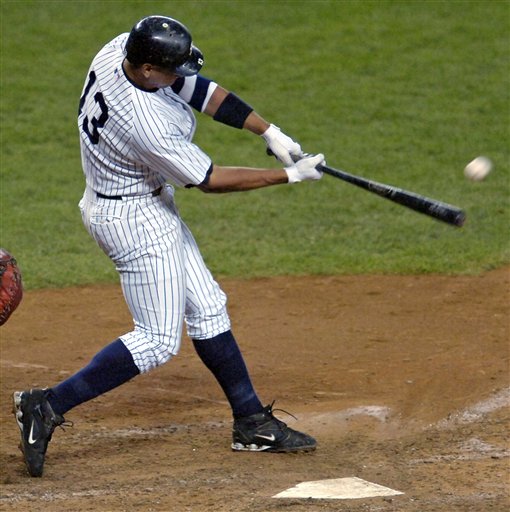

For the second straight year, the New York Yankees were eliminated from a postseason baseball series on an Alex Rodriguez strikeout.
Sports, entertainment, politics & popular culture


Normally, this fact would be of great interest to this lifelong baseball fan and former Yankees beat writer. But A-Rod’s bid to become the seventh man in major league history to hit 600 homers only reminds me of B.B. King’s biggest hit: “The Thrill is Gone.”
To cheer A-Rod’s every at-bat, as many fans will tonight at
That is because Rodriguez is a tainted player. Tainted by his own weakness of character, which compelled him to use performance-enhancing drugs.
Rodriguez has said he used illegal drugs for three years, from 2001-03, in what he described as an ill-advised attempt to justify the then-record $273 million, 10-year contract he signed with the Texas Rangers. But he still cheated the game whether he did it for three years or three games, or whether he’s still cheating in a league that does not give players in-season blood tests to detect use of human growth hormones.
It’s impossible for me to get excited about A-Rod hitting home runs because it’s impossible to know how many of his long balls have been artificially enhanced.
It’s hard to look at A-Rod and not see the player who lied to Katie Couric’s face—and to ours—when he said on “60 Minutes” he had never used illegal drugs and never, ever would.
Because of his nationally televised turn as Pinocchio, A-Rod will always be an athlete of immense talent, and almost no credibility.
The Yankee fan in me wants to see A-Rod do well only because it helps my team. But as an adult who believes it is always best to do the right thing, I find him an extremely difficult player for whom to root.
That will be the case three years from now when A-Rod is likely to hit his 700th homer. And in the year 2015 when a 40-year-old A-Rod figures to supplant another morally challenged slugger, Barry Bonds, atop the all-time home run list.
I’ll never forget the excitement of watching Monday Night Baseball on NBC on April 8, 1974, the night Henry Aaron—baseball’s true home run king—hit No. 715 off Al Downing. “Hammerin’ Hank” had eclipsed Babe Ruth, “The Bambino,” “The Sultan of Swat,” as the greatest home run hitter ever.
But on August 7, 2007, the night Bonds hit No. 756 off Mike Bacsik to surpass Aaron, I didn’t even watch the game on ESPN.
Bonds was not worthy of the most coveted individual record in team sports then, and he isn’t now. Nor is the almost certainly drug-stained Sammy Sosa worthy of his current position of sixth place on the all-time home run list, just below Willie Mays and Ken Griffey Jr.
A-Rod, barring injury or a sudden act of vengeance from the baseball gods, will pass Sosa, Griffey, Mays, Ruth, Aaron and Bonds in the next five years. And he’ll do it in the uniform of the most successful franchise in all of team sports, a franchise representing the media capital of the world.
It will be treated as a big story in many quarters. Not this one.
When A-Rod hits No. 763, I won’t hear cheering but instead the sound of B.B. King’s famous guitar Lucille:
“The thrill is gone
“The thrill has gone away…
As a veteran observer of all things Yankee, I don’t believe reports that the team’s divorce from Johnny Damon is final.
General manager Brian Cashman says the Yankees won’t resign the 36-year-old outfielder because the club needs to get younger and more athletic and keep the 2010 payroll under $200 million.
I’m not buying it.
When has payroll mattered to the New York Yankees?
The Yanks have never cared about paying a luxury tax (not even this season’s $25 million tax) for exceeding baseball’s salary threshold as long as they’re getting maximum bang for their bucks.
And a 27th World Series championship certainly qualifies as money well-spent.
During the Steinbrenner Era, the Yankees have always tried to field the best team money can buy.
The Yankees can achieve that again in 2010 if Damon takes the initiative and follows a strategy already executed by Alex Rodriguez.
No, that doesn’t mean Damon should divorce his wife and date free-agent starlet Kate Hudson.
Instead, Damon should tell agent Scott Boras exactly what A-Rod told him after negotiations with the Yankees had been severed following the ’07 season:
Butt out.
If Damon himself tells Cashman and the Steinbrenner boys, Hank and Hal, that he wants to stay, then they’ll make a deal.
Boras, in typically nauseating fashion, alienated the Yankees by saying publicly the club should give Damon the kind of multi-year deal it gave catcher Jorge Posada at age 36 and relief ace Mariano Rivera at age 39 and will give shortstop Derek Jeter who turns 36 in June.
That is not going to happen. Nor should it happen.
Jeter, Rivera and Posada have become Yankee icons. Along with southpaw Andy Pettitte, they’re the only on-field links to the dynastic Yankee teams of the late 1990s-early 2000s.
Those players have earned special treatment.
The Yankees essentially told
The Yankees then traded for former Tigers All-Star Curtis Granderson—at 29, a superior athlete and outfielder to Damon—and signed free agent Nick Johnson, an ex-Yankee whose on-base percentage is one of baseball’s best.
Damon should remind
The Yankees would offer Damon a two-year, $16-million deal if he wants it. I’ve followed this club long enough to know that.
A-Rod is a Yankee today—with a world championship on his resume, finally—because he personally told the club he wanted to stay and he muzzled
There may be more upfront money elsewhere for Damon, or even a three-year deal, but he wouldn’t be a Yankee. He wouldn’t be playing for the reigning world champions, the most celebrated franchise in professional sports, in the media capital of the world.
It can’t make more sense to Damon to finish his career with the White Sox, Orioles or Royals.
Would the Red Sox offer him a return to Beantown?
Maybe. But only to try to tweak the Yankees, the team that tweaked them when Damon signed his four-year, $52 million deal after the ’05 season.
But that move wouldn’t make sense for the Sox, who need to get younger and more athletic just like the Yankee team they’re now chasing.
Damon should want to be part of the 2010 Yankees, part of what would be one of baseball’s most potent lineups ever:
SS Derek Jeter
LF Johnny Damon
1B Mark Teixeira
3B Alex Rodriguez
C Jorge Posada
CF Curtis Granderson
2B Robinson Cano
RF Nick Swisher
DH Nick Johnson
You could quibble with the batting order. You could even bat Granderson ninth (if he’s not insulted), but this lineup coupled with the Yankees’ pitching staff would be favored to win another world championship.
Damon should want a piece of that action.
But first he needs to follow A-Rod’s lead and check his agent at the door.
For Johnny Damon to return as a New York Yankee in 2010, he will need to take a page from the Alex Rodriguez playbook.
And I don’t mean Damon needs to divorce his wife and then cavort with an aging rocker followed by a comely blonde actress in her early thirties.
What Damon needs to do is tell agent Scott Boras to curb the rhetoric because the Yankees can win in 2010 and beyond without him.
A-Rod nearly played his way out of
Taking
Only after A-Rod muzzled
Damon needs to borrow the
Clearly,
But his strategy often succeeds only in making a client a better-paid loser in a
Case in point: Former Seattle Mariner Alex Rodriguez of the Texas Rangers.
Another case in point:
Yet another: Former Texas Ranger Pudge Rodriguez of the
Damon turned 36 on November 3, the day before the left fielder helped the Yankees win their 27th league championship — a pro sports record.
Actually, November 3 was the day before Damon limped off the Yankee Stadium turf during Game 6 with a hamstring injury so severe he would have had to sit out Game 7, had there been one.
That is part of the problem: The Yankees need to get younger and more athletic in the outfield, and
According to
Yes, Damon has played in at least 140 games in 14 big-league seasons. But he played hurt more often than he should have to achieve that streak, and he has the weakest throwing arm of any starting outfielder in baseball.
According to
Clearly, Boras is suggesting the Yankees offer Damon a multi-year deal commensurate with the four-year, $52 million contract signed by catcher Jorge Posada who was 36 at the time, or the three-year, $45 million contract signed by relief ace Mariano Rivera who was about to turn 38, or the multi-year deal that shortstop Derek Jeter will sign to remain in pinstripes as a 36-year-old.
The Yankees won’t do that. Nor should they.
Damon, however important he was to the Yankees’ championship season, is not remotely as vital to the team as Posada — a switch-hitting catcher with power from both sides and a team leader — or Rivera — the finest relief pitcher in major league history.
The Yankees should offer Damon a two-year contract worth between $20 million-$22 million.
If
The Yankees could then pursue Los Angeles Angels free agent Chone Figgins, who is 31 and faster than Damon with a better arm.
The Yankees could also hope World Series Most Valuable Player Hideki Matsui recovers well enough from knee surgery to play 40-50 games in left field in 2010. Figgins, or a rotating group of players, could man the position the rest of the season.
If that happens, it would be, as Yankees legend Yogi Berra would say, “déjà vu all over again” for Damon.
The Boston Red Sox let Damon walk after their 2004 world championship when he rejected their four-year, $40 million offer.
The Yankees came to the rescue with a four-year, $52 million deal.
That won’t happen this time.
I’m old enough to be the father of most players on the 2009 New York Yankees.
But to watch them celebrate their 27th World Series championship on the field at Yankee Stadium gave me as big a thrill as their titles in the '70s when I was a teenager.
My devotion to the Yankees began in the '60s, when I first spotted them on the family’s black-and-white Zenith in my
The Yankees usually lost in those days, and their most popular player, Mickey Mantle, hobbled around the bases, a shell of the legend he had been.
Still, I knew the Yankees had the richest baseball tradition and more World Series titles than any other team.
They also looked classy in their home uniforms: white with blue pinstripes and an overlapping NY on the left breast. Athletic business suits.
The advent of free agency in the ’70s allowed tempestuous owner George Steinbrenner to pay top dollar for talent, and the Yankees became great again.
Watching free agent Reggie Jackson smash three home runs on three pitches against three different pitchers to clinch the ’77 World Series remains the greatest athletic feat I’ve ever seen.
Covering the team I rooted for as a boy was a dream job. The thrill was never greater than on October 27, 1996—the night the Yankees beat Atlanta, 3-2, to clinch their first World Series in 18 years.
Fortunately, I listened to veteran sportswriters and didn’t wear good clothes to that game because ballplayers do get a kick out of dousing reporters with champagne.
Those Yankees teams became a dynasty under manager Joe Torre, winning the World Series in 1996, ’98, ’99 and ’00.
Critics grouse that the Yankees “buy” their championships. Nonsense.
Baseball imposes no cap on players’ salaries, like football or basketball. Any baseball team can spend whatever it wants to acquire the best players.
Don’t you think Pittsburgh Pirates fans, whose team has had 17 consecutive losing seasons, wish ownership could target the right players and pay them like the Yankees?
You bet they do.
And because baseball has revenue sharing and imposes a luxury tax on teams that spend above the threshold on players’ salaries, the Yankees indirectly financed the Florida Marlins who beat them in the ’03 World Series and the Tampa Bay Rays who reached the ’08 World Series.
I love that the Yankees spend aggressively to put the best product on the field every year.
The Yankees don’t always win — this year’s title was their first since 2000 — but they always try.
Money from such revenue streams as the new $1.5 billion Yankee Stadium that opened in 2009 and the eight-year-old Yankees Entertainment and Sports Network helps the Yankees keep their core players under contract.
A quartet of young stars from the ’96 team I covered — shortstop Derek Jeter, catcher Jorge Posada, starting pitcher Andy Pettitte and relief pitcher Mariano Rivera — won their fifth World Series rings in 2009.
I’m proud of them. I’ve watched them grow up. And I look forward to the day Jeter and Rivera are enshrined in the Baseball Hall of Fame.
Money helped the Yankees surround their veteran corps with stars like third baseman Alex Rodriguez, pitchers CC Sabathia and A.J. Burnett and first baseman Mark Teixeira.
And money helped the Yankees sign Japanese slugger Hideki Matsui in 2003.
Yet even loyal Yankees fans understand baseball is a business.
Matsui is 35 now, with knees so creaky he can’t play the outfield anymore.
The Yankees will likely replace him, even though he earned World Series Most Valuable Player honors for driving in six runs with three hits in his final game.
Matsui will always have 2009, and the thrill of experiencing a championship with the team he loves.
So will I.