With Nick Swisher's defection to Cleveland via free agency this week, the New York Yankees have a hole to fill in the outfield.
But rather than repeat what the Yankees have done so often over the years--offer an overpriced, multi-year deal to a free agent and then lament their diminishing returns at the back end of the contract--the Bronx baseball braintrust should extend a modest, two-year contract to Juan Rivera.
Rivera, who will be 34 on opening day, played the outfield for the Yankees from 2001-2003. He has never been an All-Star and will never be one. But he is a righthanded hitter with a good arm, a good glove and some pop in his bat--just the kind of bench player and occasional starter the 2013 club needs.
In today's free-agent market, Rivera could be had for $8 million over two years. Or the Yankees could offer a one-year deal worth $4 million with a club option for the 2014 season.
Rivera made $4 million for the Los Angeles Dodgers in 2012. He hit .244 with 9 home runs and 47 RBI. He can also play first base, which means the Yanks could give starter Mark Teixeira a day off once in a while.
The Yankees are likely to open 2013 with a starting outfield of Brett Gardner in left, Curtis Granderson in center and Ichiro Suzuki in right. That trio should cover plenty of ground in the outfield and steal a ton of bases.
But Granderson, Gardner and Ichiro are all lefthanded hitters. That would leave the Yankees especially vulnerable to lefthanded pitching.
Signing Rivera would allow Yankees manager Joe Girardi to sit the strike zone-challenged Granderson against a particularly tough southpaw; Gardner could move to center when Granderson sits.
Rivera could also fill in for Ichiro, no spring chicken at age 38, or be a righthanded DH--a role in which Andruw Jones struggled in 2012. (Jones has signed a free-agent contract with a team in Japan.)
Admittedly, the Yankees won't make major headlines by signing Rivera. They won't break out the carving board and serve roast beef at a Yankee Stadium news conference to re-introduce Rivera to New York.
However, Rivera can help the 2013 Yankees. The club should not wait any longer to sign him.
For the second straight year, the New York Yankees were eliminated from a postseason baseball series on an Alex Rodriguez strikeout.
At least A-Rod swung and missed to end Game 5 of the 2011 American League Division Series against the Detroit Tigers. He didn't go down with his bat on his right shoulder, as he did to end the 2010 AL Championship Series against the Texas Rangers.
Still, there is no joy in Yankeeville. Once again, mighty A-Rod has struck out.
But it's time to stop bashing the 36-year-old Rodriguez. Yes, he made $30 million for the 2011 season and hit a measly .111 (2-for-18) in the ALDS. But he wasn't the only high-priced underachiever on the Yankees -- sportsworld's most profitable franchise with a net worth of $1.6 billion.
Derek Jeter, 37, failed too often in the clutch against the Tigers. Mark Teixeira and Nick Swisher, both 30, were downright awful against Detroit. And CC Sabathia, 30, was missing more than the periods in his name versus the Tigers. He lacked command of his fastball. And he allowed mediocre hitters like Brandon Inge and Ramon Santiago to beat him in Game 3.
It's time for the Yankees to get younger and more athletic, and the key to that infusion is 21-year-old Jesus Montero (pictured left). A powerfully built right-handed hitter with a quick bat, Jesus needs to become a regular in 2012.
Jesus has the potential to become a Mike Piazza-type catcher -- a consistent offensive threat with adequate defensive skills. Russell Martin, 30, the incumbent catcher, is a .230 hitter. He simply doesn't provide enough offense to start 130 games in 2012.
But if the Yankees are insistent that Martin play regularly, then they need to bench Swisher (sorry, ladies) or refuse to pick up his option for 2012 and instead convert Jesus into a right fielder.
Right field is the easiest of the three outfield positions to play at Yankee Stadium, and Jesus has a strong-enough arm to make the transition.
After being called up from the minor leagues in September, Jesus was not overmatched against major league pitching. Indeed, he showed the maturity to hit outside pitches to right field with authority, and he handled fastballs inside like a veteran.
All Jesus needs is regular playing time to become a power-hitting threat in the middle of the Yankees' lineup -- exactly what A-Rod used to be.
And Jesus might just become the postseason clutch hitter that the Yankees need. In the last several years, we've learned that A-Rod, Teixeira, Swisher and the aging Jeter are not up to the task.
Despite being the best pitcher on the most successful franchise in sports, CC Sabathia is underrated. The New York Yankees ace has won an American League-leading 40 baseball games the last two years while helping his team win the 2009 World Series. But each time, he got snubbed by voters for the Cy Young Award, which goes to the best pitcher in each major league. Cy Young voters seem to prefer pitchers who excel on lesser teams, as Sabathia did in 2007 when he won the award as a Cleveland Indian. The Yankees, with their major league-high $221 million payroll, are hardly underdogs. But Carsten Charles Sabathia — who prefers to be known as CC without the periods - seems determined to be more dominant in 2011 and beyond, whether he wins awards or not. During the winter break, the 6-foot-7 left-hander shed 25 pounds, from 315 to 290, he said, "by not eating Cap’n Crunch every day. I could eat a box at a time." Dropping that bad habit was smart. According to the product’s nutritional information, one box of the cereal contains 1,400 calories. Eating a boxful is equivalent to 10 tablespoons of sugar. Sabathia, 30, has also begun working with a personal trainer and a nutritionist. "This was just something to try to extend my career," he said. Sabathia, a four-time all-star, said he intends to lose more weight, which is fine with the Yankees because he has shown in two starts this season that he’s lost nothing off a fastball that consistently tops 90 miles per hour.
With Trevor Hoffman announcing his retirement from baseball this week, Mariano Rivera stands ready to take possession of the only significant record for relief pitchers that he does not currently hold.
Hoffman, who ended his career with the Milwaukee Brewers, retired with 601 career saves.
Rivera, the New York Yankees relief ace since 1997, has 559 saves, only 42 behind Hoffman.
The number 42 is particularly significant for Rivera. He is the only player in the major leagues still wearing No. 42.
Jackie Robinson was baseball’s most famous No. 42. Major League Baseball officially retired the number on April 15, 1997 — the 50th anniversary of Robinson becoming the majors’ first black player with the Brooklyn Dodgers.
Players who already wore No. 42 during the 1997 season were allowed to keep the number until they retired. Rivera is the only such player left.
Rivera has worn No. 42 with such distinction that he, like Robinson, will be a first-ballot Hall of Famer someday.
No relief pitcher in the history of baseball has been better than Rivera. Here’s a point-by-point comparison between Rivera and Hoffman:
Age: Rivera: 41 Hoffman: 43
Major League Baseball seasons: Rivera: 16 Hoffman: 18
Regular season saves: Rivera: 559 Hoffman: 601
Regular season games: Rivera: 978 Hoffman: 1035
Regular season ERA: Rivera: 2.23 Hoffman: 2.87
All-Star appearances: Rivera: 8 Hoffman: 7
Postseason saves: Rivera: 42 Hoffman: 4
Postseason games: Rivera: 94 Hoffman: 12
Postseason ERA: Rivera: 0.71 Hoffman: 3.46
World Series championships: Rivera: 5 Hoffman: 0
As the numbers clearly show, Rivera has been far superior to Hoffman in postseason games, when the stakes are highest and the pressure and media scrutiny are the greatest.
Only once did Rivera and Hoffman go head-to-head in the postseason. In the 1998 World Series, Rivera’s Yankees swept Hoffman’s San Diego Padres. Hoffman went 0-1 with one blown save and a 9.00 ERA while Rivera was perfect, saving all three games in which he appeared without allowing a run.
And Rivera is equally impressive off the field.
Growing up the son of a fisherman in La Chorrera, Panama, Rivera learned at an early age the value of hard work, religious faith and giving back to others.
Yet he remains humble, hard-working and altruistic despite the phenomenal success he has enjoyed as a Yankees reliever since 1995.
(When the Yankees won the 1996 World Series, Rivera excelled as John Wetteland’s set-up man. Rivera became the closer a year later.)
Married and the father of three sons, Rivera has helped finance the construction of an elementary school, a church and computer centers in his native country.
This winter, Rivera has delivered Christmas gifts to children in Bronx, NY, where the Yankees play their home games, and Panama. He does this without seeking publicity.
But his many contributions on the mound have been impossible to conceal.
Rivera dominates hitters with a devastating fastball that seems to grow teeth and bore in on hitters, often turning their bats into firewood. The fastball, along with his mental toughness and resilience, has set Rivera apart.
"I think the key to be successful in the closer role is to learn how to bounce back after the blown save or the losing circumstance," Rivera says. "Learn to come back from that and put that behind you."
Rivera overcame adversity in his first season as the Yankees’ relief ace. With the Yankees just four outs from winning the 1997 American League Division Series against the Cleveland Indians, Rivera gave up a game-tying home run to Sandy Alomar Jr. Cleveland went on to win the game and the series.
Rather than be haunted by that failure, Rivera came back stronger. He helped the Yankees win the next three World Series — and did not allow an earned run in any of his 18 postseason appearances in 1998 and ’99.
Consistency on the field and off has been a major reason for Rivera’s success. He doesn’t just kill time in the bullpen and wait to be called upon in the late innings. He remains a student of the game.
"Watch the game, pay attention to the hitters and once I do that I have some kind of idea on how to attack them," he says.
Yankees fans have come to expect satisfaction whenever Rivera emerges from the bullpen at Yankee Stadium to the tune of Metallica’s "Enter Sandman." And Rivera rarely disappoints.
Rivera, who recently signed a two-year contract worth $15 million a season, has averaged 35 saves a year during his career. That means sometime during the 2012 season, he should surpass Hoffman and become baseball’s all-time leader in saves.
Rivera is already baseball’s greatest relief pitcher ever. But after he breaks Hoffman’s record, there won’t be any doubt.
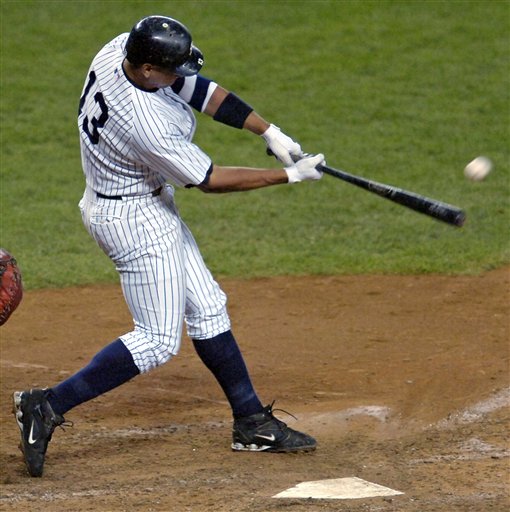
With one mighty swing on August 4, Alex Rodriguez made history.
The New York Yankees third baseman belted a fastball over the center field fence in the first inning at Yankee Stadium and became only the seventh player in Major League Baseball history to hit 600 career home runs.
Rodriguez, 35, also became the youngest player to reach the 600-home run mark. Rodriguez, a right-handed batter hit the historic home run off Toronto Blue Jays right-hander Shawn Marcum in the first inning of a game the Yankees won, 5-1.
After Rodriguez was met at home plate by his happy teammates, a crowd of 47,659 gave him a standing ovation. Because the crowd continued to cheer, Rodriguez emerged from the Yankees’ dugout and waved his batting helmet to the fans.
The other players to hit at least 600 home runs are Barry Bonds, Hank Aaron, Babe Ruth, Willie Mays, Ken Griffey Jr. and Sammy Sosa. Rodriguez is the only man on the list who is still playing.
Rodriguez hit his 599th career home run in a July 22 victory against the Kansas City Royals. That means it took him 12 games and nearly two full weeks to hit No. 600. He had gone 17 at-bats without a base hit before the big home run.
Rodriguez is a 13-time All-Star, and he has been one of baseball’s finest players since his pro career began with the Seattle Mariners in 1994. He switched from shortstop to third base when he joined the Yankees in 2004 because the Yankees already had an All-Star shortstop, Derek Jeter.
Although he is the highest-paid player in baseball, making a reported $27.5 million a year, Rodriguez is not a sure bet to make it to the Hall of Fame in Cooperstown, New York, where the sport’s greatest players are celebrated. That’s because in 2009, after many years of denials, Rodriguez admitted he took steroids – an illegal drug – to try to improve his performances earlier in his career.
Medical experts say steroids help athletes work out for a longer period of time and recover faster from a workout so they can get stronger, and that gives them an unfair advantage over other athletes.
But because Rodriguez said he took steroids in 2003, several years before baseball began testing for the illegal drug, baseball officials did not punish him for it.
Rodriguez has not failed a drug test since baseball began steroids testing. Many believe he will someday pass Bonds’s total of 762 and become baseball’s all-time home run king.
Who is ALEX RODRIGUEZ? Age: 35 Date of birth: July 27, 1975 Birthplace: New York, New York Height: 6-foot-3 Weight: 225 pounds Job: Baseball player Current team: New York Yankees Position: Third base Previous teams: Seattle Mariners, Texas Rangers Previous position: Shortstop Reported annual salary: $27.5 million Family: Divorced with two daughters
MAJOR LEAGUE BASEBALL’S ALL-TIME HOME RUN LIST (as of August 7, 2010) 1. Barry Bonds 762 2. Hank Aaron 755 3. Babe Ruth 714 4. Willie Mays 660 5. Ken Griffey Jr. 630 6. Sammy Sosa 609 7. Alex Rodriguez 600
On this his 35th birthday, Alex Rodriguez will take mighty swings for the New York Yankees in pursuit of career home run No. 600.
Normally, this fact would be of great interest to this lifelong baseball fan and former Yankees beat writer. But A-Rod’s bid to become the seventh man in major league history to hit 600 homers only reminds me of B.B. King’s biggest hit: “The Thrill is Gone.”
To cheer A-Rod’s every at-bat, as many fans will tonight at Cleveland’s Progressive Field, is to deny reality.
That is because Rodriguez is a tainted player. Tainted by his own weakness of character, which compelled him to use performance-enhancing drugs.
Rodriguez has said he used illegal drugs for three years, from 2001-03, in what he described as an ill-advised attempt to justify the then-record $273 million, 10-year contract he signed with the Texas Rangers. But he still cheated the game whether he did it for three years or three games, or whether he’s still cheating in a league that does not give players in-season blood tests to detect use of human growth hormones.
It’s impossible for me to get excited about A-Rod hitting home runs because it’s impossible to know how many of his long balls have been artificially enhanced.
It’s hard to look at A-Rod and not see the player who lied to Katie Couric’s face—and to ours—when he said on “60 Minutes” he had never used illegal drugs and never, ever would.
Because of his nationally televised turn as Pinocchio, A-Rod will always be an athlete of immense talent, and almost no credibility.
The Yankee fan in me wants to see A-Rod do well only because it helps my team. But as an adult who believes it is always best to do the right thing, I find him an extremely difficult player for whom to root.
That will be the case three years from now when A-Rod is likely to hit his 700th homer. And in the year 2015 when a 40-year-old A-Rod figures to supplant another morally challenged slugger, Barry Bonds, atop the all-time home run list.
I’ll never forget the excitement of watching Monday Night Baseball on NBC on April 8, 1974, the night Henry Aaron—baseball’s true home run king—hit No. 715 off Al Downing. “Hammerin’ Hank” had eclipsed Babe Ruth, “The Bambino,” “The Sultan of Swat,” as the greatest home run hitter ever.
But on August 7, 2007, the night Bonds hit No. 756 off Mike Bacsik to surpass Aaron, I didn’t even watch the game on ESPN.
Bonds was not worthy of the most coveted individual record in team sports then, and he isn’t now. Nor is the almost certainly drug-stained Sammy Sosa worthy of his current position of sixth place on the all-time home run list, just below Willie Mays and Ken Griffey Jr.
A-Rod, barring injury or a sudden act of vengeance from the baseball gods, will pass Sosa, Griffey, Mays, Ruth, Aaron and Bonds in the next five years. And he’ll do it in the uniform of the most successful franchise in all of team sports, a franchise representing the media capital of the world.
It will be treated as a big story in many quarters. Not this one.
When A-Rod hits No. 763, I won’t hear cheering but instead the sound of B.B. King’s famous guitar Lucille:
In light of umpire Jim Joyce's egregious call in Detroit tonight that denied Tigers right-hander Armando Galarraga a perfect game against the Cleveland Indians with two out and nobody on in the ninth inning, it is time to reprise a column I wrote last October on the pathetic state of major league baseball umpiring--and what should be done about it.
Since the 2009 postseason, baseball has done nothing to correct the atrocity that big-league umpiring has become. Thus, the work of the umpires continues to deteriorate.
Meanwhile, umpire and media hog Joe West has a publicist to tell us what city he's working in well before a series begins, which gives anyone bent on trying to fix a game exactly the kind of information he should not have.
Why MLB has not told West, "Either the publicist goes or you go," is beyond me.
West has called the New York Yankees and Boston Red Sox "a disgrace" because the teams routinely play four-hour games against each other. Perhaps having to work those games has severely cut into West's drinking time.
The real disgrace is the consistently inept work of West and his brethren in blue. Read on:
Nobody knows who’s going to win the 2009 World Series. But it is clear two weeks into the postseason who the biggest losers are: major league baseball umpires.
It has become painfully obvious that umpires can no longer call the plays in big-league games without more assistance from video replay technology.
Such technology is now used to determine disputed home run calls. Now, that same technology should be utilized to determine if a batted ball lands fair or foul, or if a player is safe or out.
There have been so many embarrassing blown calls, that it’s increasingly likely the World Series may be decided not by brilliant pitching (e.g., Orel Hershiser of the 1988 Los Angeles Dodgers), or phenomenal defense (e.g., Brooks Robinson of the 1971 Baltimore Orioles), or awe-inspiring hitting (e.g., Reggie Jackson of the 1978 New York Yankees), but rather by an umpire error.
In the fifth inning of Game 2 of the American League Championship Series, Derek Jeter was called out at first base when replays clearly showed the Yankees shortstop had beaten the throw. Instead of the Yankees having runners on 1st and 3rd with one out, they had a runner on third with two out.
Big difference.
In the 10th inning of the same game, the Yankees had the winning run on second base because an umpire ruled Los Angeles Angels shortstop Erick Aybar missed the bag on an apparent double play. Replays showed Aybar's foot brushed the bag.
Fortunately, the Yankees did not win the game because of an umpire’s misjudgment. But they could have.
Minnesota Twins fans remain convinced their team would have beaten the Yankees in Game 2 of the American League Division Series had left field umpire Phil Cuzzi not called foul an obvious leadoff double by Joe Mauer.
That Michael Cuddyer and Jason Kubel, the Twins’ next two batters, followed with base hits only added to Minnesota’s misery.
Umpire CB Bucknor personally blew three calls at first base in the opener of the Angels-Boston Red Sox A.L. Division Series.
Umpires missed three calls on the bases in Game 1 of the Philadelphia Phillies-Colorado Rockies National League Division Series.
And the Phillies’ winning rally in the ninth inning of Game 3 of the series was aided by an umpire’s mistake that put Chase Utley on base on a ball that had first hit his leg.
When viewers at home, watching frame-by-frame replays from multiple angles, are getting a better look at crucial plays than the umpires on the field, there’s a big problem.
Here’s a solution that should be implemented on Opening Day 2010:
Major League Baseball should assign a Booth Umpire to every game. The Booth Umpire will be the final arbiter on close plays on the bases, disputed home runs or whether a ball landed fair or foul.
The Booth Umpire would have the same access to frame-by-frame replays from multiple angles as TV viewers.
The Booth Umpire can buzz the home plate umpire whenever he wants to review a call, or the crew chief can ask the Booth Umpire — undoubtedly after being prompted by a team’s angry manager — to review a close call.
The argument against increased use of video replay technology is that baseball games would take too long. Well, games are already too long. The most important thing is to get the calls right.
Ball-and-strike calls would not be subject to replays. And it should not take long to decide if a ball was fair or foul, or if a runner was safe or out.
For baseball to do nothing at a time when umpires’ mistakes threaten to overshadow the excellence of the players and the excitement of the games would be the biggest error of all.
Major League Baseball returned to normal Tuesday as all 30 teams saw action. But that doesn't mean two appalling events the day before should be forgotten.
Monday, May 31 was Memorial Day, which used to mean every big-league team played a doubleheader.
Not the kind of day-night twinbill designed to make fans pay separate admissions that is in vogue today. But a real, honest-to-goodness doubleheader.
Two games for the price of one. A perfect way to bring families together and honor America's pastime.
Well, that used to be the case.
Unfortunately, Memorial Day 2010 was no different from any other during Bud Selig's reign of error as baseball commissioner.
Nobody played a doubleheader on Memorial Day.
And four American League teams, including the Boston Red Sox, did not play at all.
Even worse is the way Major League Baseball has turned Memorial Day--and the Fourth of July and Labor Day--into money grabs by having players wear "special, commemorative" caps.
White caps with blue bills and red and blue team logos are being sold for $37 apiece, with one dollar from each cap sold--one measly dollar--going to a military veterans' organization.
Major League Baseball would be far better off making a substantial donation to veterans' groups based on ticket proceeds instead of having players wear alternative caps.
Why must baseball be so transparent and phony? Clearly, the only reason to wear alternative caps on Memorial Day, the Fourth of July and Labor Day is to create a new source of revenue for Major League Baseball.
Why can't the New York Yankees look like themselves on national holidays during baseball season? Why must they don white caps befitting a corporate softball team in Central Park?
As a veteran observer of all things Yankee, I don’t believe reports that the team’s divorce from Johnny Damon is final.
General manager Brian Cashman says the Yankees won’t resign the 36-year-old outfielder because the club needs to get younger and more athletic and keep the 2010 payroll under $200 million.
I’m not buying it.
When has payroll mattered to the New York Yankees?
The Yanks have never cared about paying a luxury tax (not even this season’s $25 million tax) for exceeding baseball’s salary threshold as long as they’re getting maximum bang for their bucks.
And a 27th World Series championship certainly qualifies as money well-spent.
During the Steinbrenner Era, the Yankees have always tried to field the best team money can buy.
The Yankees can achieve that again in 2010 if Damon takes the initiative and follows a strategy already executed by Alex Rodriguez.
No, that doesn’t mean Damon should divorce his wife and date free-agent starlet Kate Hudson.
Instead, Damon should tell agent Scott Boras exactly what A-Rod told him after negotiations with the Yankees had been severed following the ’07 season:
Butt out.
If Damon himself tells Cashman and the Steinbrenner boys, Hank and Hal, that he wants to stay, then they’ll make a deal.
Boras, in typically nauseating fashion, alienated the Yankees by saying publicly the club should give Damon the kind of multi-year deal it gave catcher Jorge Posada at age 36 and relief ace Mariano Rivera at age 39 and will give shortstop Derek Jeter who turns 36 in June.
That is not going to happen. Nor should it happen.
Jeter, Rivera and Posada have become Yankee icons. Along with southpaw Andy Pettitte, they’re the only on-field links to the dynastic Yankee teams of the late 1990s-early 2000s.
Those players have earned special treatment.
Boras also used the media to tell the Yankees not to make an offer to Damon unless it’s a three-year deal.
The Yankees essentially told Boras to take a flying leap.
The Yankees then traded for former Tigers All-Star Curtis Granderson—at 29, a superior athlete and outfielder to Damon—and signed free agent Nick Johnson, an ex-Yankee whose on-base percentage is one of baseball’s best.
Damon should remind Boras that he works for the player, not the other way around.
The Yankees would offer Damon a two-year, $16-million deal if he wants it. I’ve followed this club long enough to know that.
A-Rod is a Yankee today—with a world championship on his resume, finally—because he personally told the club he wanted to stay and he muzzled Boras.
There may be more upfront money elsewhere for Damon, or even a three-year deal, but he wouldn’t be a Yankee. He wouldn’t be playing for the reigning world champions, the most celebrated franchise in professional sports, in the media capital of the world.
It can’t make more sense to Damon to finish his career with the White Sox, Orioles or Royals.
Would the Red Sox offer him a return to Beantown?
Maybe. But only to try to tweak the Yankees, the team that tweaked them when Damon signed his four-year, $52 million deal after the ’05 season.
But that move wouldn’t make sense for the Sox, who need to get younger and more athletic just like the Yankee team they’re now chasing.
Damon should want to be part of the 2010 Yankees, part of what would be one of baseball’s most potent lineups ever:
SS Derek Jeter
LF Johnny Damon
1B Mark Teixeira
3B Alex Rodriguez
CJorge Posada
CF Curtis Granderson
2B Robinson Cano
RF Nick Swisher
DH Nick Johnson
You could quibble with the batting order. You could even bat Granderson ninth (if he’s not insulted), but this lineup coupled with the Yankees’ pitching staff would be favored to win another world championship.
Damon should want a piece of that action.
But first he needs to follow A-Rod’s lead and check his agent at the door.
For the first time in New York sports history, the Major League Baseball season and NBA season both ended in November.
Not until November 5, the day after the New York Yankees won Game 6 against Philadelphia to clinch their 27th World Series title, did people in the metropolitan New York area fully comprehend how hideous the local NBA teams are.
Autopsies were being performed on the New York Knicks and New Jersey Nets while 3 million people at a victory parade showered the Yankees with confetti (and personal financial records carelessly flung by Wall Street employees).
Now, the Yankees’ brilliance is being obscured by the gloom and doom of the Knicks and Nets.
Knicks fans hope LeBron James will leave Cleveland after this season and lure another marquee free agent, like Raptors forward Chris Bosh.
But LeBron to New York seems more like a pipe dream.
What is real is the egregiousness of that collection of expiring contracts in Knicks uniforms.
President Donnie Walsh and Coach Mike D’Antoni have largely escaped public criticism because Isiah Thomas, their predecessor, was so awful.
Give Walsh credit for extricating the Knicks from salary cap purgatory.
But give Walsh hell for not drafting angelic point guard Brandon Jennings.
Jennings, taken one pick later by Milwaukee, lit up Golden State for 55 points last Saturday—the most points scored by a rookie in an NBA game since Earl “The Pearl” Monroe hit 56 for the Bullets.
Meanwhile, forward Jordan Hill, the Knicks’ first-round pick, has not earned significant playing time.
Thomas can’t be blamed for that.
Start hanging around MadisonSquareGarden to get your comp Knicks tickets—the way I used to in the early 1980s, the pre-Patrick Ewing era.
The 2-9 Knicks would be eligible for disaster aid from FEMA, except that the Nets are even worse.
The Nets, who may relocate to Brooklyn, or Newark, actually appeared in the NBA Finals twice in this decade.
The only problem facing those Nets was the animus between All-Star point guard Jason Kidd and his wife, Joumana.
Those were salad days compared to what’s happening now at IzodCenter.
The Nets’ organization knows its product isn’t good enough to draw fans. That’s why they are using ineptitude as a selling point.
Tuesday’s game against Indiana was “10 Is Enough Night.”
Why? The Nets were a league-worst 0-10. Hence, an upper-deck ticket or lower-deck end zone seat sold for $10.
Before an announced crowd of 11,332, the Nets fell to 0-11.
Nets fans might be able to spend 70 cents for a “70 Is Enough” ticket to watch the team in April.
Seriously, the Nets are selling tickets for five designated games in which every fan gets a reversible jersey—a Nets player’s name and number on one side, and that of an opposing team’s star, e.g., LeBron, on the other.
Fans at this Saturday’s game will get two tickets for the price of one.
I’m a big pro football fan, which means I’m a pawn.
I’m a pawn because I would love to have NFL Network in my home but can’t get it.
I would love to watch my San Francisco 49ers play (beat?) the Chicago Bears tonight on NFL Network without being surrounded by vile, loudmouthed drunks at a sports bar.
But I can’t do it.
Why not?
My local cable supplier, Cablevision of Westchester (New York), does not offer NFL Network.
Why not?
Cablevision and NFL Network have never been able to agree on an annual rights fee per subscriber, which is how cable networks make money.
Sports cable networks command more money per subscriber than general interest cable networks because sports networks deliver to advertisers the coveted 18-to-49 male demographic.
ESPN, for example, can get $2.80 per subscriber per year from Cablevision while CNN gets about 70 cents per subscriber per year.
Sports networks call the tune.
And sports fans get the shaft.
Since Cablevision refuses to pay what NFL Network wants per subscriber per year, pawns like me cannot get NFL Network.
Other football fans with different cable subscribers (e.g., Comcast) or satellite TV (e.g., Dish Network or DirecTV) can watch 49ers vs. Bears at home.
I can’t.
So why don’t I just get satellite TV?
I live in a Yonkers co-op that doesn’t allow satellite dishes.
“They’re ugly,” the co-op board says. “Dishes detract from the aesthetic beauty of the building.”
(Actually, there’s nothing aesthetically beautiful about my building, but that’s another issue.)
Fans are pawns because the major sports leagues know they can increase their revenues and exercise greater control over their message and image by creating their own networks.
That’s why we have NFL Network, NBA TV, NHL Network, MLB Network, Golf Channel and Tennis Channel.
And some of North America’s most popular teams have their own networks showing content or games you can’t see anywhere else.
The list includes YES (Yankees Entertainment and Sports), Dallas Cowboys TV and Toronto Maple Leafs TV.
The problem occurs whenever fans of these leagues or teams can’t watch a game because the league-owned or team-owned network is in a dispute with a cable network or satellite company.
And this happens far more often than it should.
When YES debuted in 2002, New York Yankees fans missed more than 100 games that year because of disputes between YES and various cable/satellite networks.
Hockey fans with DirecTV can't watch NHL games on Versus because DirecTV and Comcast (which owns Versus) are in a snit over money.
Pawns like me can’t watch Tennis Channel on Cablevision because the two sides can’t agree on subscriber-rights fee.
This isn’t just a rant. I have a solution:
Any sports league that doesn’t have clearance on every cable or satellite network should offer the games on its Web site for free.
For example, I should be able to watch 49ers vs. Bears tonight online at nfl.com or nflnetwork.com.
I’m not talking about game highlights. I’m talking about the entire game.
Other leagues, less greedy than the NFL, are already doing this.
During the 2009 NCAA men’s basketball tournament, fans who couldn’t watch a desired game on their local CBS station watched that game free online.
Also, fans who didn’t have Tennis Channel watched U.S. Open matches free at usopen.org.
If the NFL weren’t so greedy—and, unfortunately, the NFL has turned greed into an art form—NFL Network games would not be offered to only a select few living rooms.
And if sports fans were not already used to being treated like pawns, they would be demanding a change.
For Johnny Damon to return as a New York Yankee in 2010, he will need to take a page from the Alex Rodriguez playbook.
And I don’t mean Damon needs to divorce his wife and then cavort with an aging rocker followed by a comely blonde actress in her early thirties.
What Damon needs to do is tell agent Scott Boras to curb the rhetoric because the Yankees can win in 2010 and beyond without him.
A-Rod nearly played his way out of New York after the 2007 season.
Taking Boras’s advice, he exercised his contractual option and announced, during Game 4 of the Red Sox-Rockies World Series, that he had become a free agent.
Only after A-Rod muzzled Boras and contacted the Yankees himself did he and the club work out the 10-year deal that allowed A-Rod to finally win his first World Series title.
Damon needs to borrow the Boras muzzle from A-Rod before it’s too late.
Clearly, Boras loves to use the media to negotiate contracts for his clients.
But his strategy often succeeds only in making a client a better-paid loser in a new city while alienating the fans in the city that player left behind.
Case in point: Former Seattle Mariner Alex Rodriguez of the Texas Rangers.
Another case in point: FormerLos AngelesDodgerChan-HoPark of the Texas Rangers.
Yet another: Former Texas Ranger Pudge Rodriguez of the Detroit Tigers.
Damon turned 36 on November 3, the day before the left fielder helped the Yankees win their 27th league championship — a pro sports record.
Actually, November 3 was the day before Damon limped off the Yankee Stadium turf during Game 6 with a hamstring injury so severe he would have had to sit out Game 7, had there been one.
That is part of the problem: The Yankees need to get younger and more athletic in the outfield, and Boras’s rhetoric could compel the team to look elsewhere for a left fielder.
According to Boras, Damon’s durability is “off the charts.”
Yes, Damon has played in at least 140 games in 14 big-league seasons. But he played hurt more often than he should have to achieve that streak, and he has the weakest throwing arm of any starting outfielder in baseball.
According to Boras, the Yankees should pay Damon “market value” for a player of his age and track record.
Clearly, Boras is suggesting the Yankees offer Damon a multi-year deal commensurate with the four-year, $52 million contract signed by catcher Jorge Posada who was 36 at the time, or the three-year, $45 million contract signed by relief ace Mariano Rivera who was about to turn 38, or the multi-year deal that shortstop Derek Jeter will sign to remain in pinstripes as a 36-year-old.
The Yankees won’t do that. Nor should they.
Damon, however important he was to the Yankees’ championship season, is not remotely as vital to the team as Posada — a switch-hitting catcher with power from both sides and a team leader — or Rivera — the finest relief pitcher in major league history.
The Yankees should offer Damon a two-year contract worth between $20 million-$22 million.
If Boras convinces Damon the offer isn’t good enough…Sayonara.
The Yankees could then pursue Los Angeles Angels free agent Chone Figgins, who is 31 and faster than Damon with a better arm.
The Yankees could also hope World Series Most Valuable Player Hideki Matsui recovers well enough from knee surgery to play 40-50 games in left field in 2010. Figgins, or a rotating group of players, could man the position the rest of the season.
If that happens, it would be, as Yankees legend Yogi Berra would say, “déjà vu all over again” for Damon.
The Boston Red Sox let Damon walk after their 2004 world championship when he rejected their four-year, $40 million offer.
The Yankees came to the rescue with a four-year, $52 million deal.
That won’t happen this time.
Boras seems blissfully unaware of that. It is up to Damon to muzzle his media-loving agent while explaining it.
My father was a Baptist minister and rooted for the New York Mets. But even at age 5, I knew he didn’t consider the Mets God’s team.
Not unless he knew that God couldn’t watch baseball without laughing because, at the time, the Mets were the biggest joke in the sport.
Logic actually dictated my father’s choice. Born on the Caribbean island of Barbados, he grew up playing cricket, baseball’s older British-born cousin.
When he immigrated to Brooklyn, he soon learned that to Americans cricket is a critter that keeps a light sleeper up at night or a top hat-wearing crooner in a Disney cartoon.
Dad chose baseball because it was the closest thing to cricket, and he chose Jackie Robinson as his favorite player because the Brooklyn Dodger was the closest thing to an icon on God’s earth.
The black community turned out in force to see Robinson once he shattered the color barrier in Major League Baseball on April 15, 1947.
Dad came to Brooklyn largely because Robinson played there.
Dad taught me how Robinson stared down racism and paved the way for a new generation of black stars in major league baseball, and how Robinson asserted his manhood with every step, every gesture, and every utterance.
Dad’s third-favorite place, after home and church, was Ebbets Field, the home of the Dodgers.
Being a Dodger fan allowed him to sit among crowds infinitely more integrated than the rest of America.
When the Dodgers traded Robinson to the New York Giants after the 1956 season, Robinson retired rather than suit up for the Dodgers’ arch rivals.
"Good for him," was Dad’s reaction.
And when the Dodgers broke Brooklyn’s heart and left for Los Angeles after the 1957 season, and took the Giants to California with them, Dad's reaction was, "Good riddance."
What Dad never said was, "Let’s go Yankees!"
Dad simply abstained from rooting for any major league team from 1957 to 1962, the year National League baseball returned to New York — well, sort of — in the form of the Mets.
Dad treated the Mets as lineal descendants of the Dodgers and Giants, which of course they were not.
The rational side of Dad’s brain knew the Metropolitan Baseball Club of New York was little more than baseball’s naked effort to capitalize financially on fans eager to support a second pro baseball team in the nation’s largest city.
"So why didn’t you just switch to the Yankees?" I asked with youthful naiveté.
Dad glared at me as if I had questioned God’s existence. I’ll never forget him sitting me down and explaining with the patience of Job, "If you were black then and you knew what was going on, you didn’t root for the Yankees.
"The Yankees," he said, virtually expectorating the words, "they didn’t want black players. That American League, especially the Yankees and Boston, they didn’t want black players."
That I would learn was an incontrovertible fact, almost as perplexing to my young mind as the knowledge that some black Africans had participated in the slave trade.
I said almost.
The New York Yankees did not have a black player until Elston Howard in 1955 — eight years after Robinson’s Dodgers debut, seven years after Roy Campanella joined the Dodgers, six years after Monte Irvin suited up for the Giants, and the year after the Giants won the World Series with a young black star named Willie Mays running down everything in center field!
Boston? Pitiful Boston was the last major league team to field an African-American player: Pumpsie Green in 1959.
"The Yankees saw the Giants win the World Series with black stars, and the Giants played at the Polo Grounds in Manhattan," Dad explained.
"And the Dodgers, playing right here in Brooklyn, finally beat the Yankees in the ’55 World Series with black stars — Jackie, Campy [Campanella], Don Newcombe. The Yankees knew by then they had to get with the program and sign some black fellas. But for the longest time, they didn’t want us."
That’s why Dad didn’t like the Yankees.
And my brother Andrew, three years older than I, didn’t like the Yankees either because he was going through that phase in which he wanted to be exactly like Dad in every way.
For whatever reason, I never went through that phase.
Dad was a minister. I grew up to become a journalist and author.
Dad and Andrew rooted passionately for the Mets. I rooted just as passionately for the Yankees — a team that had black players by the time Dad introduced me to baseball.
I sometimes reminisce about the passionate arguments I used to have with my father and brother about baseball:
Which team is better, Yankees or Mets?
Which was the better ballpark to watch a game, Yankee Stadium or Shea Stadium?
I still can’t believe they thought that Flushing dump was somehow superior to the great ballpark in the Bronx.
Dad and Andrew are gone now. So are Shea Stadium and the original Yankee Stadium. How I miss the fun and passion of those arguments.
And how grateful I am to have had a father who instilled in me and nurtured a love of baseball — a truly beautiful game, no matter how much today’s players try to ruin it.
As someone who covered the dynastic New York Yankees in the mid-1990s, I had to laugh at the oft-repeated comment that this year’s World Series championship is for the team’s principal owner, George Steinbrenner.
At the victory celebration at City Hall last Friday, speaker after speaker, from Mayor Bloomberg to manager Joe Girardi to captain Derek Jeter to broadcaster Suzyn Waldman, said, “This one is for The Boss.”
So all the other championships won during Steinbrenner’s reign, which began in 1973, were for somebody else?
For whom? Frank Sinatra? Team mascot Rudy Giuliani?
Every Yankees championship during the Steinbrenner Era—1977, 1978, 1996, 1998, 1999, 2000 and 2009—has been for The Boss.
It’s still his team. It’s still his money.
Apparently, the aforementioned speakers felt better about declaring the Yankees’ 27th World Series title as one for The Boss.
After all, George M. Steinbrenner III is 79 years old.
Steinbrenner is the Lion in Winter, no longer running the team in hands-on fashion, having ceded those responsibilities to sons Hal and Hank.
Steinbrenner is no longer the clenched face of the Yankees’ franchise.
Indeed, if an article by Franz Lidz in Portfolio magazine last year can be believed—and I believe it—Steinbrenner suffers from dementia and is not fully aware of what is happening with the franchise.
Statements issued nowadays by the Yankees in Steinbrenner’s name are actually written by the office of his publicist, Howard Rubenstein.
This lends a certain Wizard of Oz aspect to Steinbrenner’s current status.
Before the postseason, the Yankees announced Steinbrenner would attend some games at the new Yankee Stadium.
He did not.
When the Yankees received their world championship trophy on the field last Wednesday night, The Boss was neither seen nor heard.
I can only hope he knows what his team accomplished and will long enjoy the memories of the 2009 season with family and friends.
During my years as a Yankees beat writer, Steinbrenner was at his megalomaniacal best (or worst), not above big-timing me by selectively handing out choice information to reporters at larger media organizations.
On many occasions during Yankees’ spring training, when Steinbrenner was accessible, I urged him to return my phone calls during the season because my editors had become convinced that I was being outworked by competitors at other newspapers.
“Absolutely,” Steinbrenner would say. “A lot of my players live in Westchester during the season. And [manager Joe] Torre lives in Westchester, too. I’ll take care of you. Don’t worry.”
Then, a new baseball season would begin, and Steinbrenner would run his New York-based team from his adopted hometown of Tampa, and my phone calls would go largely unreturned.
Whenever people ask me what I think of Steinbrenner, I always say I would like him more if I had never met him.
That’s because a Yankee fan’s perspective would have been all I had.
Steinbrenner has always spent liberally and aggressively to assemble the best team money can buy.
His teams don’t always win, but you can’t help but appreciate a team owner who wants to win just as much as the fans.
Here is my favorite Steinbrenner story, one that gets better with age, even though the Yankees owner ended up big-timing me again:
At the 1996 Olympic Games in Atlanta, where I covered boxing for Gannett News Service and USA Today, I tried to set up a one-on-one interview with Steinbrenner, then a vice president for the U.S. Olympic Committee.
I thought such an interview would not only be newsworthy, but that it would also impress the executive editor at Gannett-Westchester who had also personalized my inability to get Steinbrenner to talk to me.
Except that the executive editor’s personalization faulted me, not Steinbrenner.
I had already gone through the media liaison for USA Boxing to request a few minutes of Steinbrenner’s time that day at the boxing venue, GeorgiaTechUniversity.
Steinbrenner showed up, as scheduled, and was booed by thousands of spectators when he was introduced between rounds of a fight.
Right after Angelo Dundee, Muhammad Ali’s former trainer, was introduced to hearty cheers, Steinbrenner was roundly booed.
I couldn’t pass up an opportunity to ask a spectator from a country where baseball is not at all popular why he would boo Steinbrenner.
So I asked a young man seated several rows behind me, a member of the Mongolian boxing team.
With a wide grin, the Mongolian said, “He greedy.”
Wonderful!
I planned to ask Steinbrenner about the Mongolian’s response—my last question, not my first—but I didn’t get the chance.
I saw Steinbrenner head for the exit during the next round. I ran after him and got his attention.
“No, I haven’t forgotten,” he said. “We’ll talk. I have to do something for NBC. But we’ll talk.”
“You’re coming back then?” I asked quickly because I had to stay to cover the fights.
“We’ll talk,” he said again before leaving.
I never saw him again during the Olympics, and I was unable to get him on the phone. A USA Boxing official told me Steinbrenner might have stayed longer if not for the booing.
Well, The Boss would have been cheered wildly in New York last week.
CECIL HARRIS manages www.CecilHarrisBooks.blogspot.com. He is the author of Charging the Net: A History of Blacks in Tennis from Althea Gibson and Arthur Ashe to the Williams Sisters (Ivan R. Dee), a New York Times' Editors' Choice selection; Call the Yankees My Daddy (Lyons Press); and Breaking the Ice: The Black Experience in Professional Hockey (Insomniac Press).
At Gannett Newspapers, Cecil became the first full-time black beat writer to cover the Yankees, earning awards for his coverage. He has also written for Newsday, the New York Post, The (Raleigh) News & Observer, The Indianapolis Star, Sporting News, The Hockey News and The New York Times.
Cecil graduated summa cum laude from Fordham University. He has taught at Concordia College. He writes and edits for New York Road Runners. He lives in Yonkers, New York.
Reach me at CecilHarris2008@gmail.com