In the aftermath of the earthquake in Haiti, there is no need to exploit the immense human suffering on the impoverished Caribbean island.
Unfortunately, a CNN crew ignored that fact.
Scenes of Haitians seeking food, water, medical attention and information about the fate of loved ones are heart-wrenching enough.
But just as bad are the manufactured scenes.
On Friday night, Anderson Cooper’s CNN program showed footage of reporter Chris Lawrence in the midst of a crush of Haitians trying to get biscuits distributed from the back of a truck by relief workers.
“You can see the incredible chaos here!” Lawrence yells over the noise of people yearning for their first taste of food in days.
“Everybody pushing and shoving, desperate for anything to eat,” Lawrence shouts while being jostled from side to side and back and forth.
Lawrence had no business positioning himself, and a camera/sound person we did not see, in the midst of the tumult.
Whoever at CNN decided to inject Lawrence into the scene should be fired.
Two hours earlier, I saw the same footage on BBC News, but shot from a wider angle.
And the BBC reporter—who, like Lawrence, gets to sleep in a warm bed in a hotel room in Santo Domingo, Dominican Republic, at the end of every grim day—did not insinuate himself into the chaos.
After Lawrence’s piece, he appeared in a live shot with Cooper as darkness had descended upon the Haitian capital of Port-au-Prince.
“Here’s what those people were so desperate for,” he tells Cooper, holding up what he described as a biscuit in a white wrapper.
Did Lawrence really have to take a biscuit just to play show-and-tell on CNN?
Of course not.
Why not simply show footage of a Haitian holding a biscuit?
But CNN found it more important to exploit the story rather than report it.
Tragically, there will be many more casualties in Haiti.
Basic human decency from news-gathering organizations need not be one of them.
If you text “Yele” to 501501 on your cell phone, a $5 donation will be made to the Haitian relief effort. Your cell phone will be charged $5.
Text “Haiti” to 90999 on your cell phone and a $10 donation will go to the Red Cross for Haitian relief efforts. Your cell phone will be charged $10.
I’m a big pro football fan, which means I’m a pawn.
I’m a pawn because I would love to have NFL Network in my home but can’t get it.
I would love to watch my San Francisco 49ers play (beat?) the Chicago Bears tonight on NFL Network without being surrounded by vile, loudmouthed drunks at a sports bar.
But I can’t do it.
Why not?
My local cable supplier, Cablevision of Westchester (New York), does not offer NFL Network.
Why not?
Cablevision and NFL Network have never been able to agree on an annual rights fee per subscriber, which is how cable networks make money.
Sports cable networks command more money per subscriber than general interest cable networks because sports networks deliver to advertisers the coveted 18-to-49 male demographic.
ESPN, for example, can get $2.80 per subscriber per year from Cablevision while CNN gets about 70 cents per subscriber per year.
Sports networks call the tune.
And sports fans get the shaft.
Since Cablevision refuses to pay what NFL Network wants per subscriber per year, pawns like me cannot get NFL Network.
Other football fans with different cable subscribers (e.g., Comcast) or satellite TV (e.g., Dish Network or DirecTV) can watch 49ers vs. Bears at home.
I can’t.
So why don’t I just get satellite TV?
I live in a Yonkers co-op that doesn’t allow satellite dishes.
“They’re ugly,” the co-op board says. “Dishes detract from the aesthetic beauty of the building.”
(Actually, there’s nothing aesthetically beautiful about my building, but that’s another issue.)
Fans are pawns because the major sports leagues know they can increase their revenues and exercise greater control over their message and image by creating their own networks.
That’s why we have NFL Network, NBA TV, NHL Network, MLB Network, Golf Channel and Tennis Channel.
And some of North America’s most popular teams have their own networks showing content or games you can’t see anywhere else.
The list includes YES (Yankees Entertainment and Sports), Dallas Cowboys TV and Toronto Maple Leafs TV.
The problem occurs whenever fans of these leagues or teams can’t watch a game because the league-owned or team-owned network is in a dispute with a cable network or satellite company.
And this happens far more often than it should.
When YES debuted in 2002, New York Yankees fans missed more than 100 games that year because of disputes between YES and various cable/satellite networks.
Hockey fans with DirecTV can't watch NHL games on Versus because DirecTV and Comcast (which owns Versus) are in a snit over money.
Pawns like me can’t watch Tennis Channel on Cablevision because the two sides can’t agree on subscriber-rights fee.
This isn’t just a rant. I have a solution:
Any sports league that doesn’t have clearance on every cable or satellite network should offer the games on its Web site for free.
For example, I should be able to watch 49ers vs. Bears tonight online at nfl.com or nflnetwork.com.
I’m not talking about game highlights. I’m talking about the entire game.
Other leagues, less greedy than the NFL, are already doing this.
During the 2009 NCAA men’s basketball tournament, fans who couldn’t watch a desired game on their local CBS station watched that game free online.
Also, fans who didn’t have Tennis Channel watched U.S. Open matches free at usopen.org.
If the NFL weren’t so greedy—and, unfortunately, the NFL has turned greed into an art form—NFL Network games would not be offered to only a select few living rooms.
And if sports fans were not already used to being treated like pawns, they would be demanding a change.
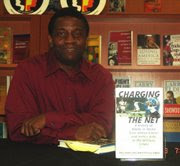
CECIL HARRIS manages www.CecilHarrisBooks.blogspot.com. He is the author of Charging the Net: A History of Blacks in Tennis from Althea Gibson and Arthur Ashe to the Williams Sisters (Ivan R. Dee), a New York Times' Editors' Choice selection; Call the Yankees My Daddy (Lyons Press); and Breaking the Ice: The Black Experience in Professional Hockey (Insomniac Press).
At Gannett Newspapers, Cecil became the first full-time black beat writer to cover the Yankees, earning awards for his coverage. He has also written for Newsday, the New York Post, The (Raleigh) News & Observer, The Indianapolis Star, Sporting News, The Hockey News and The New York Times.
Cecil graduated summa cum laude from Fordham University. He has taught at Concordia College. He writes and edits for New York Road Runners. He lives in Yonkers, New York.
Reach me at CecilHarris2008@gmail.com