On the day after the New York City Marathon, I always watch "Late Show with David Letterman" and wait for the moment when that year’s marathon champions jog onto the stage during Letterman’s monologue and, without saying a word, run down the steps, up the aisle and out of the theater as the audience applauds.
Letterman always tells us who the runners are, but we never hear from them. Often, that’s because the winners are Africans who aren’t fluent in English.
That’s not the case with this year’s men’s champion: Meb Keflezighi (Kef-LEHZ-gee).
He was born in the African nation of Eritrea, in a village without electricity. He’s also a U.S. citizen, a San Diego resident and a UCLA graduate with a compelling story.
He deserves more than the usual token jog on "Letterman."
Meb’s parents moved his family of 11 children out of Eritrea when a war against Ethiopia would have forced a boy his age into the military.
The Keflezighis lived briefly in Italy, as a safe haven. But the family’s intention was always to come to the USA and live its version of the American Dream.
Meb became a U.S. citizen in 1998, and became a four-time NCAA champion in middle-distance running. He still holds the U.S. record at 10,000 meters (27 minutes, 13.98 seconds set in 2001).
Meb then turned to the marathon and became one of the world’s best, winning the Olympic silver medal in 2004 and, less than two months later, finishing second in the New York City Marathon.
But Meb’s career was thought to be over two years ago when, at age 32, he suffered a stress fracture in his hip during the U.S. Olympic Trials Marathon in New York. The pain was so intense he had to literally crawl to the bathroom.
The self-appointed experts in distance running wrote Meb off. He had never actually won a marathon.
Meb was too old, they said. Broken down. Washed up.
Ryan Hall, a fair-haired Californian and Meb’s close friend, was America’s great marathon hope, they said.
But Meb refused to quit.
He had already proven an American could compete well against the best marathon runners in the world. On Sunday, he proved an American could beat the best.
Pulling away from a strong field in the 24th mile, Meb won the race in a personal-best time of 2 hours, 9 minutes, 15 seconds.
He is the first African-American champion in the 40-year history of the race, and the first American to win in New York since Alberto Salazar in 1982.
And because the New York City Marathon and USA Men’s Marathon Championship were held concurrently, Meb won his first two marathon titles on the same day.
"You visualize it and visualize it and when reality hits, it’s pretty sweet," said Meb, who defeated runner-up Robert K. Cheruiyot of Kenya, a four-time Boston Marathon champion, by 41 seconds.
Meb wore a USA jersey to which he pointed with pride as he had ran alone to the finish line. He pocketed $200,000--$130,000 for the New York City Marathon title, $40,000 for the USA Men’s Marathon crown and a $30,000 time bonus for finishing in under 2:10.
Meb, a married father of two, now has a "platform." Now, he’s a "name." And that's why he got a well-deserved speaking role on "Letterman."
"Ladies and gentlemen," Letterman intoned, "here is tonight’s Top 10 List delivered by your 2009 New York City Marathon champion, Meb Keflezighi!"
It was a turbulent year, 1968. On April 4 Dr. Martin Luther King Jr. was assassinated in Memphis, Tennessee, where he had gone to support a strike by local sanitation workers.
On June 9 Robert F. Kennedy, Jr., was assassinated in Los Angeles, at the Ambassador Hotel, minutes after speaking to cheering supporters following a victory in the California primary that might have carried him to the Democratic Party nomination for President of the United States.
The civil rights movement raged on, with scenes of rioting, looting, police brutality, and major urban cities set ablaze by those who, in the words of Mississippi activist Fannie Lou Hamer, were "sick and tired of being sick and tired."
And the Vietnam War continued apace with its disturbing visual images of death and inhumanity reaching into America’s living rooms.
In August, after he emerged as champion of the U.S. Nationals amateur tournament and shortly before play began at the inaugural U.S. Open on the new professional circuit, Arthur had dinner with a friend and fellow tennis player, a white South African named Ray Moore.
As they dined, they watched on television sickening scenes of rioting and police clubbing protesters and journalists on the streets of Chicago during the Democratic National Convention.
The two men often discussed politics and social issues, including the human rights struggle in Ashe’s homeland and the human rights struggle in Moore’s, to which much of the world had turned a blind eye.
The rule of law in Moore’s homeland was apartheid—the systematic separation of races, categorized in descending order as whites, coloreds, and blacks, and the oppression of a black majority of twenty million persons by three million whites of Dutch descent called Afrikaners, who were convinced that God had mandated their right to rule.
"Arthur and I used to discuss interminably what to do about apartheid: what’s meaningful and what’s not," Moore said. "We were both vehemently opposed to apartheid, however we differed on how best to fight it."
Apartheid outraged Lt. Arthur Ashe, Jr., then a tennis-playing officer in the United States Army. Acceptance of injustice was never part of his persona.
In 1967 he disturbed his superior officers with a public reference to South Africa’s capital city:
"Somebody should drop a hydrogen bomb on Johannesburg."
As Ashe and Moore continued to watch all hell break loose in Chicago, they talked about a quote they had seen in that day’s newspaper from rock musician Frank Zappa, leader of a band called Mothers of Invention: "The way to stop all the violence in Chicago is for the hippies to cut their hair and infiltrate the police force."
The two discussed the concept of fighting against apartheid from the inside. Arthur then decided he needed to reach out to the South African government to receive permission to visit the country to compete in the South African Open tournament—not as an "honorary white" but as a black man—and build a platform in the United States to support such an unprecedented act. That, Arthur believed, would be the most effective way to show the apartheid regime in South Africa the error of its ways and begin to sway public opinion.
It would take years for Arthur to cut through the swath of political red tape and get a visa to visit South Africa.
In 1969 and 1970 his applications were rejected by the South African government. In 1970 Arthur, then the No. 2 player in the world, and top-ranked Stan Smith visited four African nations (Kenya, Tanzania, Uganda, and Nigeria) for a series of tennis exhibitions and social events.
Arthur would also visit Cameroon the following year. He spoke of his wish to be appointed U.S. ambassador to South Africa, but that notion sounded as fanciful at the time as his ever setting foot in that country.
After all, why would a racially oppressive regime grant entry to someone who said its largest city should be A-bombed?
Arthur filed another visa application in 1973, and negotiations with South African officials continued. Among those advocating for Arthur were Robert Kelleher, a federal judge in Los Angeles who was Arthur’s first Davis Cup captain; Donald Dell, a Washington, D.C., attorney and Arthur’s agent; and Andrew Young, who in 1972 became Georgia’s first black congressman since Reconstruction.
The South African government did not want Arthur to visit, but it felt swayed somewhat by the argument that a trip by Arthur without incident could benefit the country’s image enough to lift the international sports ban that kept South Africa out of the Olympics and other high-profile events.
With both sides determined to get what they wanted from the deal, the visa application finally was accepted. In November 1973, Arthur visited South Africa.
"That trip was the start of change in South Africa—very small change," Moore said. "It was like Rosa Parks refusing to get up from her seat on the bus [in Montgomery, Alabama on December 1, 1955]. It was one small act that would have a much bigger impact."
Before the trip Arthur faced opposition from African-American activists. "People said, ‘No, you shouldn’t go. Why go all the way to South Africa for a cause when we’ve got problems right here?’" Moore remembered.
"Uncle Tom" became one of the kinder criticisms leveled at Arthur. But Ashe argued that the situation for blacks in South Africa under the foot of apartheid was worse than the situation facing African Americans.
As a black man he was not told by the U.S. government where to live. He could travel freely to any country on the globe, which would now include South Africa, whereas South African blacks were forced to live in government-created dwellings called homelands.
South African blacks did not have the right to vote. South African blacks were forced to carry passes with their personal identification that were to be presented to white authorities on demand.
South African blacks could be officially labeled "a banned person," or jailed by the government, as in the case of African National Congress leader Nelson Mandela, imprisoned since 1963 on RobbenIsland.
"I feel I have some credibility in talking about South Africa," Arthur wrote in his 1981 autobiography, Off the Court. "I was brought up under a similar situation, having lived in the segregated South. I have more feeling being black, intuitively, than some northerner who may have a false feeling of integration."
Arthur believed that in going to South Africa he "could play a significant role as far as raising the level of awareness within the white community both in South Africa and the United States."
Arthur set several conditions for his trip, all of which were approved by the South African government: (1) there would be no segregated audiences at the tournament in Johannesburg; (2) he would not have "honorary white" status, rather he would be recognized by white South Africa as a black man; (3) he would not have to stay in a segregated area; and (4) he could go anywhere he pleased and say anything he wanted.
A few American sports journalists accompanied him on the trip, including Frank Deford of Sports Illustrated, with whom he wrote his first memoir, Portrait in Motion, in the 1970s, and Bud Collins of the Boston Globe.
Shortly after Arthur’s arrival he had a chance meeting on the street with a colored South African poet and activist named Don Matera, regarded by his fans as "the poet of compassion."
The apartheid regime had declared Matera a "banned person," meaning he could not work, could not appear at any public event, could not speak publicly, could not be quoted by any media, and could not be in the presence of anyone other than a family member.
But when Matera heard that Arthur would be meeting that evening with a group of black South African journalists, he risked breaking an unjust law to try to talk with the American.
"When we were approaching the hall, there was a man standing by a telephone pole; it was Matera," Bud Collins recalled. "Arthur knew who he was. I didn’t. He introduced himself, and there were guys across the street watching him. The police. He said, ‘I can’t talk to you long, but good luck.’ The meeting with the black journalists was a real emotional setback for Arthur, because when he got up to speak—and we were told there were a lot of plants in the audience—a lot of people there were very critical of him. They were saying, ‘Why did you come, Arthur? You’re just making the government look good for letting you in. When you’re gone, they’ll still be kicking our black asses.’ Things like that were said. I remember that very well. Arthur was very unsettled."
Had his critics in America been proven right? Was Arthur being used by a South African government intent on getting back into the Olympic Games with no real intention of granting basic human rights to an oppressed black majority? Had he done the wrong thing by setting foot in the land of apartheid?
When Arthur left the hall Matera was still waiting outside. The words of an artist and activist whom Arthur respected, a man he did not expect to meet because of his "banned" status, fortified him and renewed his commitment to the cause.
"Obviously, Matera had known those sorts of statements would be made inside, and he could see Arthur was shaken," Collins said. "He said, ‘Arthur, you have done the right thing to come here, because you have shown our black children that a black man can succeed in a white world.’"
Arthur also visited the South African homelands, white-created dwellings for blacks designed to disfranchise them and dilute their political strength. He visited the impoverished township of Soweto, where in 1976 a violent uprising would take place resulting in the massacre of hundreds of blacks.
On this day in 1973, a makeshift tennis court was fashioned under a bridge near a schoolhouse and hundreds watched, some hanging on to fences, as Arthur, the black tennis champion from America, and Moore, the white South African tennis star, shared their craft and instilled a sense of hope.
A young black man named Mark Mathabane, wrote that he was inspired by the 1973 trip.
Mathabane’s life under apartheid and subsequent journey to America was chronicled in an autobiography, Kaffir Boy. ("Kaffir" is an Afrikaner slur equivalent to "nigger.")
The 1973 South African Open at Ellis Park was the first event under apartheid rule to have integrated seating. Moore, who did not compete in the event, made a point of sitting in a section previously reserved for blacks.
There were black ball boys, and a few black South Africans competed in the tournament—dressing side by side with whites in an integrated locker room for the first time. The atmosphere in the locker room was said to be cold enough to store meat.
Blacks, who had essentially been taught not to look a white person in the eye, did not initiate any locker-room chatter with their white counterparts.
Whites, not used to being on equal footing with blacks, silently simmered rather than bring their resentment to a boil. For South Africa this constituted radical change.
Arthur partnered with Tom Okker, a Dutchman, to win the doubles championship, 6-2, 4-6, 6-4, but he lost to Jimmy Connors in the singles final, 6-4, 7-6, 6-3. He played quite well considering his full itinerary of meetings and fact-finding tours, and his startling encounters with the black journalists and with a distinguished professor from StellenboschUniversity in Capetown who could not believe the intelligent and well-spoken Ashe was really black.
"You are an exception," he told Arthur. "You are not completely black. You have some white blood in you."
Arthur hoped his trip would raise consciousness about South Africa among pro athletes, particularly tennis players, boxers, and golfers, who were accepting substantial appearance fees to compete in the country.
"I asked Arthur what South Africa was like because I had considered going there for a tournament," said Kim Sands, the black pro from Miami. "He told me being in South Africa was like stuffing yourself with twenty pancakes and then having to eat twenty more. It just made you totally sick inside. After hearing that, I didn’t go."
Arthur also hoped the international media would begin to hold accountable white South African athletes such as Gary Player, who routinely dismissed queries about apartheid with the line, "I’m a golfer, not a politician."
But Arthur truly hoped that his first of several trips to South Africa would help bring an end to the apartheid regime. Change did not come as swiftly as he expected, but eventually it came. He had made a difference.
In 1990, Nelson Mandela was released from prison. In 1992 South Africa returned to the Olympic Games for the first time in thirty-two years. In 1994 Mandela was elected president in South Africa’s first all-races election.
Arthur remembered feeling "semi-satisfied" with his tennis performance on the 1973 trip to South Africa, because of the loss to Connors. Two years later he would have another shot at Connors and a chance to write history of a different sort.
In light of umpire Jim Joyce's egregious call in Detroit tonight that denied Tigers right-hander Armando Galarraga a perfect game against the Cleveland Indians with two out and nobody on in the ninth inning, it is time to reprise a column I wrote last October on the pathetic state of major league baseball umpiring--and what should be done about it.
Since the 2009 postseason, baseball has done nothing to correct the atrocity that big-league umpiring has become. Thus, the work of the umpires continues to deteriorate.
Meanwhile, umpire and media hog Joe West has a publicist to tell us what city he's working in well before a series begins, which gives anyone bent on trying to fix a game exactly the kind of information he should not have.
Why MLB has not told West, "Either the publicist goes or you go," is beyond me.
West has called the New York Yankees and Boston Red Sox "a disgrace" because the teams routinely play four-hour games against each other. Perhaps having to work those games has severely cut into West's drinking time.
The real disgrace is the consistently inept work of West and his brethren in blue. Read on:
Nobody knows who’s going to win the 2009 World Series. But it is clear two weeks into the postseason who the biggest losers are: major league baseball umpires.
It has become painfully obvious that umpires can no longer call the plays in big-league games without more assistance from video replay technology.
Such technology is now used to determine disputed home run calls. Now, that same technology should be utilized to determine if a batted ball lands fair or foul, or if a player is safe or out.
There have been so many embarrassing blown calls, that it’s increasingly likely the World Series may be decided not by brilliant pitching (e.g., Orel Hershiser of the 1988 Los Angeles Dodgers), or phenomenal defense (e.g., Brooks Robinson of the 1971 Baltimore Orioles), or awe-inspiring hitting (e.g., Reggie Jackson of the 1978 New York Yankees), but rather by an umpire error.
In the fifth inning of Game 2 of the American League Championship Series, Derek Jeter was called out at first base when replays clearly showed the Yankees shortstop had beaten the throw. Instead of the Yankees having runners on 1st and 3rd with one out, they had a runner on third with two out.
Big difference.
In the 10th inning of the same game, the Yankees had the winning run on second base because an umpire ruled Los Angeles Angels shortstop Erick Aybar missed the bag on an apparent double play. Replays showed Aybar's foot brushed the bag.
Fortunately, the Yankees did not win the game because of an umpire’s misjudgment. But they could have.
Minnesota Twins fans remain convinced their team would have beaten the Yankees in Game 2 of the American League Division Series had left field umpire Phil Cuzzi not called foul an obvious leadoff double by Joe Mauer.
That Michael Cuddyer and Jason Kubel, the Twins’ next two batters, followed with base hits only added to Minnesota’s misery.
Umpire CB Bucknor personally blew three calls at first base in the opener of the Angels-Boston Red Sox A.L. Division Series.
Umpires missed three calls on the bases in Game 1 of the Philadelphia Phillies-Colorado Rockies National League Division Series.
And the Phillies’ winning rally in the ninth inning of Game 3 of the series was aided by an umpire’s mistake that put Chase Utley on base on a ball that had first hit his leg.
When viewers at home, watching frame-by-frame replays from multiple angles, are getting a better look at crucial plays than the umpires on the field, there’s a big problem.
Here’s a solution that should be implemented on Opening Day 2010:
Major League Baseball should assign a Booth Umpire to every game. The Booth Umpire will be the final arbiter on close plays on the bases, disputed home runs or whether a ball landed fair or foul.
The Booth Umpire would have the same access to frame-by-frame replays from multiple angles as TV viewers.
The Booth Umpire can buzz the home plate umpire whenever he wants to review a call, or the crew chief can ask the Booth Umpire — undoubtedly after being prompted by a team’s angry manager — to review a close call.
The argument against increased use of video replay technology is that baseball games would take too long. Well, games are already too long. The most important thing is to get the calls right.
Ball-and-strike calls would not be subject to replays. And it should not take long to decide if a ball was fair or foul, or if a runner was safe or out.
For baseball to do nothing at a time when umpires’ mistakes threaten to overshadow the excellence of the players and the excitement of the games would be the biggest error of all.
Major League Baseball returned to normal Tuesday as all 30 teams saw action. But that doesn't mean two appalling events the day before should be forgotten.
Monday, May 31 was Memorial Day, which used to mean every big-league team played a doubleheader.
Not the kind of day-night twinbill designed to make fans pay separate admissions that is in vogue today. But a real, honest-to-goodness doubleheader.
Two games for the price of one. A perfect way to bring families together and honor America's pastime.
Well, that used to be the case.
Unfortunately, Memorial Day 2010 was no different from any other during Bud Selig's reign of error as baseball commissioner.
Nobody played a doubleheader on Memorial Day.
And four American League teams, including the Boston Red Sox, did not play at all.
Even worse is the way Major League Baseball has turned Memorial Day--and the Fourth of July and Labor Day--into money grabs by having players wear "special, commemorative" caps.
White caps with blue bills and red and blue team logos are being sold for $37 apiece, with one dollar from each cap sold--one measly dollar--going to a military veterans' organization.
Major League Baseball would be far better off making a substantial donation to veterans' groups based on ticket proceeds instead of having players wear alternative caps.
Why must baseball be so transparent and phony? Clearly, the only reason to wear alternative caps on Memorial Day, the Fourth of July and Labor Day is to create a new source of revenue for Major League Baseball.
Why can't the New York Yankees look like themselves on national holidays during baseball season? Why must they don white caps befitting a corporate softball team in Central Park?
The myth that basketball superstar LeBron James will sign as a free agent with the New York Knicks picks up steam this week because the influential New York magazine is telling us in a cover story why it should happen.
Nice try, New York.
Particularly cute was the Photoshopped cover image of LeBron appearing to pull an orange-and-blue suitcase on wheels complete with the Knicks logo and an I Love New York button.
But LeBron, the NBA’s most dynamic talent, will not come to the Knicks because there is no compelling reason for him to leave the Cleveland Cavaliers.
First, the supporting players with whom LeBron runs in Cleveland (Mo Williams, Antwan Jamison, Shaquille O’Neal, Anderson Varejao, Delonte West et al.) are far better than his Knicks’ supporting cast would be.
And that would be true even if the Knicks could convince free agent power forward Chris Bosh to leave the Toronto Raptors and join LeBron in New York.
Second, it is no longer necessary for a great athlete to play for a New York team to maximize his earning potential. This is not the late 1970s when Reggie Jackson’s baseball star ascended once he traded his Oakland A’s and Baltimore Orioles uniforms for Yankee pinstripes.
Nowadays, a great athlete in a team sport can play anywhere and rack in major endorsement dollars.
Just ask Peyton Manning of the Indianapolis Colts.
I lived in Indianapolis in 2001 and '02. Even the locals call it "India-no-place" and "Naptown."
Sidney Crosby is the most marketable star in hockey. He’s not a New York Ranger or New York Islander or New Jersey Devil. Crosby works his on-ice magic in a Pittsburgh Penguins uniform.
While it is true that Yankees shortstop Derek Jeter earns more money in endorsements than any other baseball player — a reported $35 million a year — Jeter rakes in the big bucks because his team wins championships — four World Series rings in his first five full seasons — and his image is squeaky clean.
If LeBron stays in Cleveland and lead the Cavs to their first-ever NBA title, he’ll be well on his way to becoming the world’s second billionaire athlete (after Tiger Woods).
LeBron does not need NEW YORK across his chest to become filthy rich. He already is.
If LeBron, a native of Akron, Ohio, were to leave the Buckeye state for New York, his image would change overnight, and not for the better.
No one perceives LeBron as greedy today. But many would consider him greedy if he leaves a place where he is revered to become the latest bold-faced name in New York City.
And athletes who are perceived as greedy and opportunistic do not rank high on the marketability scale.
At least New York put LeBron on its cover in a Cavaliers jersey, not in a Knicks jersey with No. 6 — the number he says he’ll switch to next season because he wants No. 23 to be retired in honor of Michael Jordan. (A New York Post article last week put LeBron in a No. 6 Knicks home jersey.)
By the way, Jordan did not need to play for the Knicks to validate his greatness.
The comedian Dave Chappelle does a riff in which he asserts that you know a man is famous when if someone performs fellatio on him, then that person becomes famous.
Chappelle used former White House intern Monica Lewinsky as a case in point.
I was reminded of Chappelle’s riff when a parade of women appeared in articles in tabloids and magazines and on TV gossip shows after alleging to have had sexual relations with golf legend Tiger Woods.
No one would care about any of those women were it not for the famous man to whom they so desperately cling.
Surely, Tiger would fire those women if he could, the same way he fired his former caddie, Fluff Cowan, for extreme publicity-seeking away from the golf course.
Perhaps Tiger will also fire his swing coach, Hank Haney — not only for publicity-seeking, but also for poor results.
Were it not for his association with Tiger, Haney would not have had his own so-called reality show on The Golf Channel last year, "The Hank Haney Project: Charles Barkley."
Each week, on this prime-time program, Haney attempted to fix the massive hitch in the golf swing of Barkley, the basketball Hall of Famer. Whether or not Haney succeeded doesn’t matter. Barkley is merely a recreational player.
What matters is whether Haney can fix Tiger’s now-broken golf game, particularly his shockingly errant tee shots.
Even before Tiger withdrew from today’s final round of The Players Championship in Ponte Verde Beach, Florida, with what he believes is a bulging disc in his neck, his game bore no resemblance to the one that made him the sport’s dominant player.
Tiger was never a contender at this year’s TPC, one week after missing the cut at the Quail Hollow tournament in Charlotte.
And with 2010 Masters champion Phil Mickelson playing superior golf, Tiger’s hold on the world’s No. 1 ranking has become tenuous at best.
Perhaps not coincidentally, Butch Harmon, who coached Tiger during his most successful years on the pro tour, now coaches Mickelson.
Some golf analysts, including Johnny Miller of NBC and Brandel Chamblee of The Golf Channel, fault Tiger and Haney for changing the swing that made Tiger so great.
Tiger holds the driver differently, with his thumbs down instead of wrapped around the club, Chamblee argues.
Tiger’s follow through is not nearly as smooth as it used to be, asserts Miller, a former U.S. Open champion.
Miller also says Tiger should spend every night watching highlights of himself winning the 2000 US Open at Pebble Beach by a record 15 strokes — paying strict attention to how he gripped the clubs and swung them — because that is the finest golf Miller has ever seen.
Of course, Tiger still suffers from the humiliation of being outed as a serial philanderer. But his golf game, especially his awe-inspiring tee shots, used to be above reproach.
Not anymore.
Tiger needs in his corner not a reality-show seeker, but a truly devoted coach who can resuscitate a limp golf game.
Tiger Woods is only two strokes behind the leaders with two rounds to play at The Masters tournament in Augusta, Ga.
Golf’s player of the decade, in more ways than one, is just 36 holes from winning his 15th major title, which would leave him three shy of the all-time leader, Jack Nicklaus.
But it is worth remembering that the last time Tiger was in this enviable position, he imploded.
Last August, he led the PGA Championships by four strokes heading into the third round. Yet he played cautiously, sluggishly, and, by his lofty standards, sloppily, allowing anyone in the field to climb back into the tournament.
The only one to take Tiger up on the challenge was Y.E. Yang, a wiry South Korean known only to golf fanatics in his own country.
Yang moved into second place, two shots behind Tiger going into the final round, and was paired with the world’s No. 1 golfer on Sunday.
As we now know, Yang became the only golfer to overtake Tiger on the final day of a major, shooting a 2-under-par 70 to Tiger’s 3-over-par 75 to win the PGA title by three strokes.
In light of what we now know about Tiger’s serial philandering prior to Thanksgiving weekend 2009, it is entirely likely his energy at the PGA tournament had been sapped by a series of sexual threesomes, or intense one-on-one rendezvous with a woman not named Elin Woods.
No wonder Tiger blew the PGA. It’s a wonder that didn’t happen more often. It’s stunning that all the cheating and lying had not caused his majestic golf game to collapse sooner.
We don’t really know Tiger Woods, no matter how often we see him, with or without a club in his hand and that TW cap covering his receding hairline.
But it’s a safe bit that he’ll never tell us whether sexual recklessness was a factor in his meltdown at last year’s PGA. It’s also safe to wager that whatever woman or women he may have spent illicit time with during that tournament received a princely sum to remain silent.
I still root for Tiger to win tournaments, especially majors. I want Tiger to break Nicklaus’s record. It is because of Tiger that I started watching golf—during his victorious run as a 21-year-old at the 1997 Masters.
I root even harder for Tiger the man to live an honest life, mentally and spiritually. I root for him to be a better human being. Whether his marriage survives or not, I root for him to be a better father to his two children.
As much as I would love to know what happened to him at last year’s PGA, I’m sure Tiger will never tell that tale. So the fan in me hopes he seizes this golden opportunity and wins Masters title No. 5.
Better to see Tiger Woods morph from the world’s No. 1 punch line back into the world’s greatest golfer.
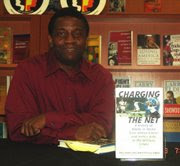
CECIL HARRIS manages www.CecilHarrisBooks.blogspot.com. He is the author of Charging the Net: A History of Blacks in Tennis from Althea Gibson and Arthur Ashe to the Williams Sisters (Ivan R. Dee), a New York Times' Editors' Choice selection; Call the Yankees My Daddy (Lyons Press); and Breaking the Ice: The Black Experience in Professional Hockey (Insomniac Press).
At Gannett Newspapers, Cecil became the first full-time black beat writer to cover the Yankees, earning awards for his coverage. He has also written for Newsday, the New York Post, The (Raleigh) News & Observer, The Indianapolis Star, Sporting News, The Hockey News and The New York Times.
Cecil graduated summa cum laude from Fordham University. He has taught at Concordia College. He writes and edits for New York Road Runners. He lives in Yonkers, New York.
Reach me at CecilHarris2008@gmail.com